

The Ultimate Pen Lexicon: All Important Terms Regarding Ballpoints, Fountain Pens, and More
When purchasing ballpoint pens, rollerballs, and fountain pens, you often encounter technical terms. These help you better understand the characteristics of a pen and thus choose the right model.
The prerequisite for this, however, is knowing the terms. Some are self-explanatory even for laypeople, while others require a bit of expert knowledge.
We would like to share this knowledge with you – in our comprehensive pen lexicon.
FAQ
A-nibs or beginner nibs for fountain pens are characterized by very effortless writing. They are made of stainless steel and are robust. This makes them ideal for students learning to write in primary school.
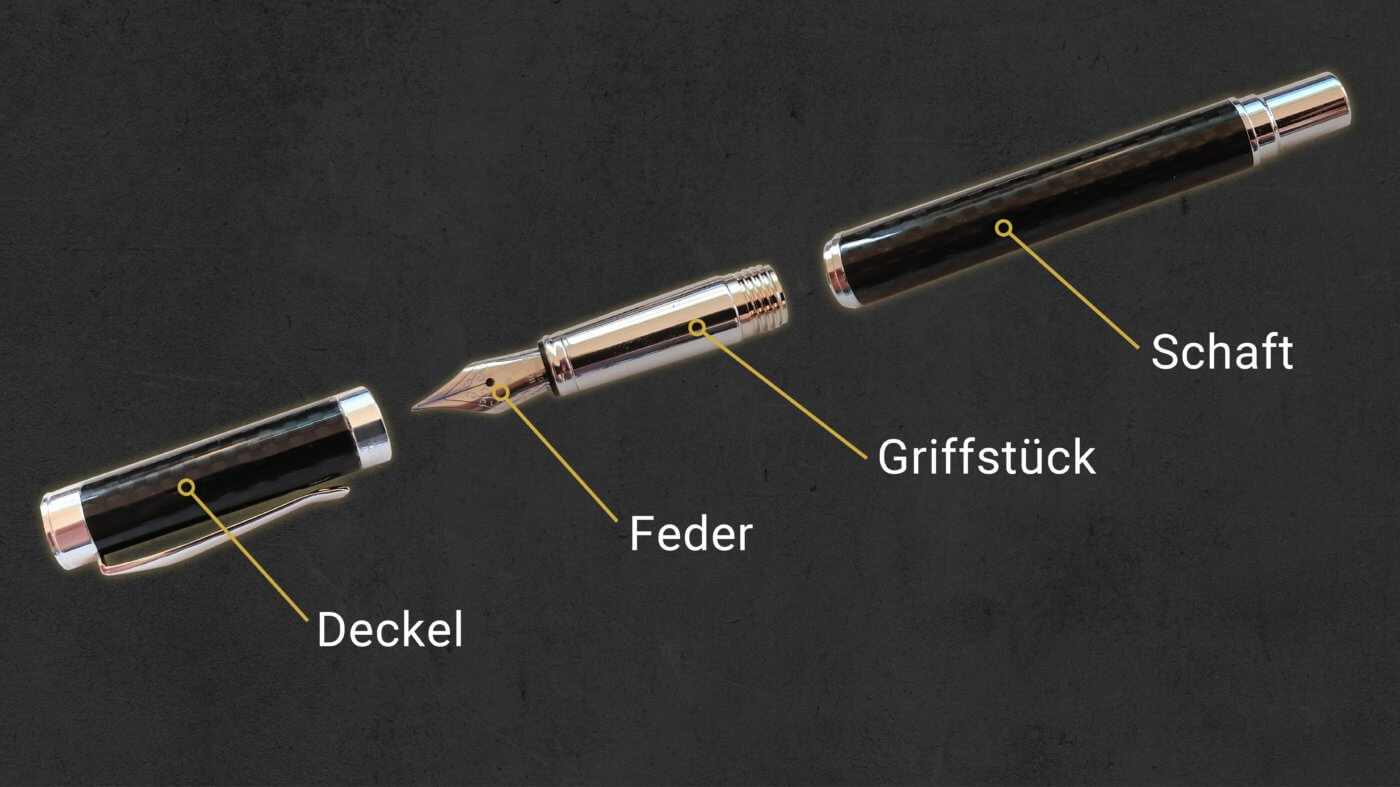
Ballpoint pens, rollerballs, and fountain pens are all constructed similarly in general terms: they have a barrel, a grip section, and a refill or nib through which the ink reaches the paper. In addition, there is often a cap or lid that protects the pen from drying out. A clip allows the pen to be conveniently attached to a jacket. In terms of material, the barrel and other parts can differ greatly. The quality of a pen depends, among other things, on the solidity of the material used.
An important criterion when choosing a pen is its balance. This indicates how it feels in the hand. A well-balanced ballpoint pen has its center of gravity between the grip and the barrel, i.e., between the two contact points in the writer’s hand.
The clip is part of the cap or lid of a ballpoint pen, rollerball, or fountain pen. It allows the pen to be attached to a suit or in a conference folder.
The cap (also called a lid) protects the pen from drying out. It is placed on the barrel and thus seals the rollerball or fountain pen when it is not in use.
Document-proof inks are characterized by high durability. They are long-lasting and are used to sign contracts or important documents. Inks are document-proof if they dry quickly, cannot be removed without a trace, and are also lightfast, meaning they do not fade completely even under sunlight.
Ballpoint pen refills can be extended and retracted in various ways. The most common variants include the clicker (push-button) and the twist mechanism. While in the first technique the refill is moved by pressing (clicking) a push lever at the rear end of the barrel, in the twist mechanism this happens via a screw mechanism in the barrel in a gentler and noiseless manner.
This ink is one of the oldest types of ink still in use. Two millennia ago, people were already writing with iron gall ink, a mixture of iron sulfate and gall nuts. From the Middle Ages to the early 20th century, it was widespread; meanwhile, all sorts of other ink types have largely replaced it – but not completely.
Color plays a role in various places for a pen. Naturally in the choice of the pen body itself, but especially in the decision for the writing color. Blue and black inks are common, but almost all other colors are also available. Those who frequently switch between different writing colors should opt for a piston fountain pen or choose a converter for their cartridge fountain pen to be able to exchange and refill the ink as needed.
The heart of a fountain pen is the nib. It is available in various shapes and designs, can consist of different materials (gold nib vs. steel nib), and has different widths (nib width). It is important to choose the right nib for your own writing style so that the fountain pen does not scratch while writing, and then to clean and maintain it regularly.
The nib of a fountain pen can have different widths. Nib width primarily refers to the width of the tip through which the ink reaches the paper. Almost all sizes are available, from EF nibs (extra fine) to M nibs (medium) to BB nibs (extra broad). There is no uniform standard for nib widths; every manufacturer offers their own nibs. In our article “Nib Guide from A to XF: Which Nib is Right for the Fountain Pen,” we provide an overview of the most common formats.
The shape of ballpoint pens, rollerballs, and fountain pens can sometimes vary slightly. Some pens are slimmer, others more bulbous. Writers with large hands have problems with slim ballpoint pens because they cannot grip them well. The shape is therefore an important selection criterion when buying a pen.
Fountain pens, also called Füllfederhalter, are pens where the ink is applied to the paper via a nib. Fountain pens are particularly well-suited for learning to write – which is why they are used in primary schools. Furthermore, there are numerous other reasons to write with a fountain pen: for example, the ink flows very smoothly onto the paper, which is why the wrist is not heavily strained and the pen is suitable for frequent writers.
One of the most important criteria for classifying a ballpoint pen, rollerball, or fountain pen is – besides the balance – its weight. To ensure the pen sits well and securely in the hand, it must not be too light or too heavy. High-quality ballpoint pens weigh around 35 grams – but the perfect weight is always a matter of personal taste.
To change the refill or cartridge, ballpoints, fountain pens, and the like can usually be unscrewed. The thread often turns out to be a critical point of a pen. Plastic threads can break quickly, which is why care should be taken when purchasing to ensure that a metal thread is installed.
The nibs of fountain pens can consist of different materials. Gold nibs and steel nibs are the most common. Both have their respective characteristics. Since gold is slightly less hard, gold nibs write more softly. However, stainless steel nibs are usually equal to the more expensive gold nibs in practice. In our article “Gold Nib vs. Steel Nib: Which Nib is Better?,” we compare both materials and give tips on what to look for when buying.
Between the barrel and the refill or nib of a pen is the grip section. Ideally, it should be specially finished so that the thumb and index finger can grasp it securely. Grooves worked into the metal or a rubber coating can increase the grip.
There is no standard size for ballpoint pens and the like, but most pens are very similar in length, shape, and diameter. Empirical values regarding when a pen sits well in the hand are decisive. For certain occasions and applications, however, pens can also deviate from the classic size – such as our Obscurus wooden ballpoint pen, which fits comfortably in a jacket pocket and is thus always at hand.
In addition to the typical materials for pens such as plastic and metal, wood also plays an important role. Aside from aesthetic reasons, the sustainability and environmental compatibility of wood as a raw material are also decisive. Popular types of wood for ballpoint pens and fountain pens include rosewood and ebony.
The piston fountain pen is one of the fountain pen types alongside the cartridge fountain pen. Unlike the cartridge fountain pen, where the ink is supplied via an insertable ink cartridge, in the piston fountain pen, this happens via a component built into the pen, the piston. This can be individually filled with ink, allowing the ink to be varied as desired.
If you cannot decide between a cartridge fountain pen and a piston fountain pen, you can easily have both. For cartridge fountain pens, there are converters that can be used instead of an ink cartridge. These converters can be filled with ink and take over the role of the piston in a piston fountain pen.
Ballpoint pens are a special variant of ink-based pens where the ink is applied to the paper via a rotating ball. The idea for this came from a Hungarian who was inspired by marbles that leave a wet trail when they roll through a puddle. Interesting, isn’t it? In our article “Who Invented the Ballpoint Pen?,” we tell exactly how it came about that everyone writes with a ballpoint today.
While ballpoint pens and rollerballs are typical ambidextrous pens, left-handers often struggle with fountain pens. For them, there are special left-handed nibs (LH nibs). They are ground in such a way that they do not scratch when writing despite the different way of guiding the pen.
So far, we have received only positive feedback from left-handers regarding our nibs, which is why we do not have LH nibs in our range.
Pens can consist of very different materials. Plastic, metal, wood: the more solid, the higher the quality. Those who want to enjoy their ballpoint pen, fountain pen, or rollerball for as long as possible choose metal – especially at the sensitive points, such as the thread. Wood stands for an elegant look and makes every pen unique due to the always different grain. Plastic, on the other hand, is widespread in mass-produced goods such as cheap promotional ballpoint pens.
When choosing a pen, the material it is made of plays a decisive role. Metals such as stainless steel or carbon increase the longevity of ballpoint pens and fountain pens. Especially the thread, which is prone to breakage, should be made of metal.
M nibs are medium-width nibs and are used as standard for most fountain pens. The line width of these nibs is around 0.6 mm. This allows for both writing longer texts and signing documents.
The ballpoint pen refill or rollerball refill is the heart of a ballpoint or rollerball. Similar to the nibs of fountain pens, refills are also available in different sizes and provide a varying line weight. For pleasant writing, soft Softline refills are recommended.
The ink differs between ballpoint pens, rollerballs, and fountain pens. While oil-based ink is used for ballpoint pens, which is thicker, the ink in rollerballs and fountain pens is water-based and thinner. This has to do with the respective writing properties of the pens.
In most cases, the ink in a fountain pen is stored in a cartridge or ink cartridge. These can be bought in stores and plugged onto the fountain pen. In parallel, there are also other filling systems. In a piston fountain pen, the ink is filled directly into the designated piston and can be refilled or exchanged as needed. Those who own a cartridge fountain pen but do not want to miss out on the advantages of a piston fountain pen can get a converter. This can be plugged on instead of a cartridge and replaces the piston.
Unlike the piston fountain pen, the second type of fountain pen, the ink in a cartridge fountain pen does not reach the ink feed and further to the nib via a refillable piston, but via a cartridge. These can be purchased commercially. Universal cartridges fit every cartridge fountain pen and are available with various ink fillings.
Universal cartridges fit our fountain pens. We recommend Pelikan 4001 ink cartridges for Hörner fountain pens.
Plastic or synthetic material is one of the most common materials from which ballpoint pens are made. The advantage: the pens can be manufactured and offered at a low price. However, the low price has an impact on quality. Unlike metal or wooden ballpoint pens, plastic ballpoint pens do not last very long and tend to break at the thread.
Rollerballs are also known as Roller Ball Pens. The ink reaches the paper via a ball, similar to a ballpoint pen – hence the English designation Roller Ball.
The barrel is the part of a pen that contains the ink refill or ink cartridge. It is connected via a thread to the grip section, where the ballpoint pen, rollerball, or fountain pen is held during writing.
The writing length of a rollerball or ballpoint pen refill indicates how much you can write with this refill. The value is usually given in meters or kilometers. Good standard refills for ballpoint pens write for about 11 kilometers, soft refills about half that. Rollerball refills reach 1 to 1.5 kilometers.
The line width, writing width, or stroke width indicates how wide a pen or refill writes. Commercially available pens write with a width between 0.4 and 0.8 mm, whereby the value depends on the type of nib or refill, the field of application, and personal preferences. Signature pens often write slightly wider, frequent-writer pens slightly narrower. The most widespread are so-called M nibs or M refills (medium width), which are suitable for almost all purposes.
Ink is the elixir of writing. Whether ballpoint pen, rollerball, or fountain pen: it is always the ink that ensures clean writing on the paper. Ink is available in countless designs and compositions, from pigmented inks to iron gall ink to gel inks. In our article “What You Always Wanted to Know About Ink,” we describe very clearly what ink consists of, which ink is best for writing, and how you can make it yourself.
A rollerball is a pen that combines the advantages of a ballpoint pen (ink is applied to the paper via a ball) with those of a fountain pen (the ink is very thin and the pen is well-suited for frequent writers).
The closure type indicates the technology with which a ballpoint pen or rollerball extends and retracts the refill. Common types are screw closures or slide-in closures, where the refill glides gently back into the pen.
In addition to the writing length of a ballpoint pen refill or rollerball refill, softness is another criterion that plays a role in the selection. Softness indicates how smoothly a refill writes on the paper, i.e., how hard the writer has to press. High softness when writing means that the ink transfers to the paper almost by itself without much effort.
Not only can the refills and cartridges be replaced in pens, but also several other parts. A whole range of accessories for ballpoint pens, rollerballs, and fountain pens is available in the stationery shop, starting from special nibs (for example, calligraphy nibs) to converters.
Have you stumbled across a term that is not yet in our pen lexicon? Simply write to us and we will be happy to help you further.