
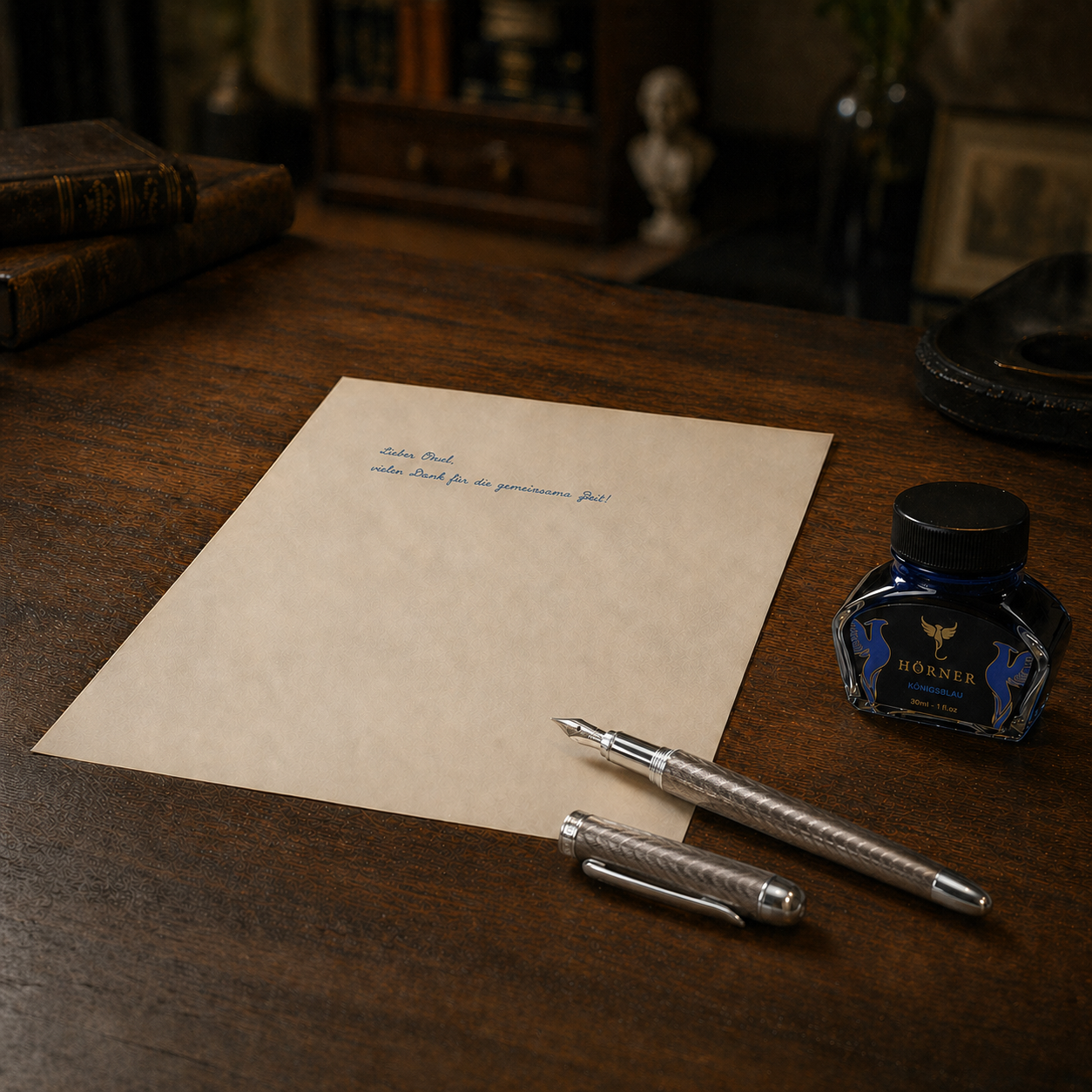
A sympathy card begins with a short expression of condolence such as "My deepest sympathy" or "With sincere condolences". Add a personal memory of the deceased and close with an offer of support. Write by hand. Three to five honest sentences are worth more than a whole page full of clichés.
The first words: What you should really write.
The most common concern when writing a sympathy card is the fear of saying the wrong thing. It can be resolved with a single thought: A sympathy card should not contain what sounds clever, but what is meant honestly. The bereaved recognise the difference immediately. Three sincere sentences are worth more than a whole page full of funeral quotes.
A good sympathy card contains three things: a short expression of condolence, a personal thought about the deceased or the bereaved, and a closing greeting. Nothing more is needed. If you can't think of a personal sentence, that's fine too. It is better to write little and honestly than a lot and made up.
Write by hand. A handwritten card shows that you have taken the time. Use a pen that allows you to write calmly, as the handwriting leaves an impression on the card. A quickly scribbled card is worse than a typed one. But a calmly written card with the right pen is often kept for years.
| What works | What doesn't work |
|---|---|
| A specific memory of the deceased | General clichés from the book of condolences |
| A specific offer of help ("I'll call next week") | Vague "Let me know if you need anything" |
| "I can't imagine how hard this is" | "I know exactly how you feel" |
| Simple closing formulas like "With sincere condolences" | Religious formulas if you don't know the relationship |
| Handwritten, calm, with a good pen | Typed, with a cliché stamp or illegible handwriting |
Let us suggest a text.
If you know the structure but can't find the words, our sympathy card generator will provide a suggestion. Four details are enough: salutation, relationship, an anecdote or characteristic, and the first name of the deceased. You will receive a text that you can use freely or have us write directly as an A4 letter on premium paper.
The structure of a sympathy card in five steps.
A sympathy card follows a simple pattern. Anyone who sticks to it will never get stuck, even when words are difficult. The five steps are: salutation, expression of condolence, personal words, comfort or offer, closing. Not every step has to be detailed, but every step belongs.
| Step | Content | Example |
|---|---|---|
| 1. Salutation | Personal, appropriate to the relationship | "Dear Mrs Miller", "Dear Thomas", "Dear Weber Family" |
| 2. Condolence | One or two sentences of sincere sympathy | "The news of your husband's death has deeply affected me." |
| 3. Personal | A memory, a thank you, a thought about the deceased | "I remember his patience and his dry sense of humour." |
| 4. Comfort or offer | Wishing strength or offering concrete help | "I'll call you next week, if that's alright with you." |
| 5. Closing | Simple closing formula, signature | "With sincere condolences, [Name]" |
Step 3 is the step that distinguishes a sympathy card from a cliché. If you knew the deceased, write a specific memory. A characteristic, a habit, a moment. If you didn't know them, write a sentence about the bereaved: "I am thinking of you and your daughter especially during this time." This too is personal, even if the deceased was a stranger.
Three sentences that you really mean are better than a whole page full of funeral quotes. The bereaved read every card with different eyes than the one who wrote it.From practice · Andre Hörner
Templates for every relationship: 30+ phrases.
The following templates are sorted according to the relationship you had with the deceased or the bereaved. Do not adopt them literally, but adapt them to your language and your specific situation. A template is a starting point, not a finished card.
For close friends and family
"Dear Anna, I can hardly believe that Peter is no longer here. He was a person who made every room brighter. I am thinking of you and am here for you whenever you need me. From the heart, [Name]"
"Dear Thomas, your mother was a special woman. I still remember her humour and her warmth well. This loss hurts. My thoughts are with you and I will get in touch next week. Yours, [Name]"
"Dear [Name] family, the memory of [Name of deceased] will live on in our hearts. What a great person. We mourn with you. With love, [Name]"
For neighbours and acquaintances
"Dear Mrs Miller, the news of your husband's death has saddened me very much. My sincere condolences. I wish you and your family much strength during this difficult time. With sincere condolences, [Name]"
"Our deepest condolences on the loss of your father. We are thinking of you and your family. With deepest sympathy, the [Name] family"
"The news has touched us deeply. We wish you strength and confidence. With sympathy, [Name]"
For work colleagues and business partners
"Dear Ms Smith, on behalf of the entire team, I express our sincere condolences to you. Take the time you need. We are here for you. With heartfelt sympathy, [Name]"
"Dear Mr Weber, we were very shocked to hear of the death of your wife. Our thoughts are with you and your family. Sincere condolences, [Name]"
On the death of an elderly person
"Dear Maria, even though your father had a long, fulfilled life, the parting hurts. A person like him leaves a great void. My thoughts are with you. Sincerely, [Name]"
"A long life lies behind her, and yet the loss is immeasurable. We wish you beautiful memories and comfort. With sympathy, [Name]"
On a sudden death
"The news has left us stunned. We can hardly grasp it. Our deepest sympathy goes out to you and your family. We are here for you. In quiet mourning, [Name]"
"Incomprehensible. Our thoughts are with you and we will drop by in the next few days. Sincerely, [Name]"
On the death of a child
"There are no words for what has happened. We can only say: we are thinking of you, every day. And we are here whenever you need us. In deep sympathy, [Name]"
"We mourn with you for [Name]. We know that there is no comfort for this. But we wanted you to know that we are thinking of you. With love, [Name]"
Comforting phrases to add.
Sometimes a single sentence is enough. If you don't want to or can't write a whole card, the following phrases are often sufficient. They are also suitable as a supplement to a more detailed card, for example under the signature or as a second paragraph.
| Phrase | Suitable for |
|---|---|
| "With sincere condolences." | General, acquaintances, colleagues |
| "My deepest sympathy." | General, polite-distant |
| "We mourn with you." | If several people are writing |
| "The memory remains." | If the deceased was important to many |
| "My thoughts are with you." | Acquaintances, distant relatives |
| "He will remain unforgotten." | On the death of an acquaintance or neighbour |
| "Wishing you strength for the time ahead." | General closing greeting |
| "In quiet remembrance." | Formal, business |
| "Life ends, love does not." | For close relationships, use sparingly |
| "Their path leads into our hearts." | For close relationships, use sparingly |
Well-known funeral quotes and citations often seem hollow to those in mourning if they are noticeably chosen as a cliché. Only use a quote if it actually fits the deceased or the relationship. A short, honest personal phrase is always the better choice if in doubt.
Short templates when words fail.
There are situations in which longer texts do not fit: for casual acquaintances, for business partners, for an entry in the book of condolences or simply when words fail. These three to five sentences are enough. They do not have less impact, but often more, because no cliché dilutes the honest core.
| Occasion | Template |
|---|---|
| Book of condolences entry | "In quiet mourning and with sincere condolences. [Name]" |
| Distant acquaintances | "I was very shocked to hear of the death of your husband. My sincere condolences. [Name]" |
| Neighbours | "Dear Weber family, our deepest condolences. If we can help, please let us know. [Name], House 14" |
| Business partners | "Dear Ms Smith, on behalf of our company, we express our sincere condolences to you. Sincere condolences, [Name]" |
| Sent by post later (delayed) | "Dear Mrs Weber, I have only just heard of the loss of your husband. Even though my words come late, I am thinking of you. Sincere condolences, [Name]" |
| Colleagues (team card) | "Dear Ms Smith, the entire team is thinking of you. Take the time you need. With sympathy, [Team Name]" |
Salutation, envelope and postage.
Formal details are often overlooked but are immediately noticed by the bereaved. A wrong salutation, a crumpled envelope, a brightly coloured stamp: small things that disturb the serious occasion. The following overview clarifies the most common questions.
| Aspect | Recommendation |
|---|---|
| Salutation (closely familiar) | "Dear Anna", "Dear Thomas", "Dear [Surname] Family" |
| Salutation (neighbours, acquaintances) | "Dear Mrs Miller" or "Dear Ms Miller" |
| Salutation (business) | "Dear Mrs [Surname]", formal, with surname |
| Addressee on the envelope | Closest relative or "The [Surname] Family" |
| Note on the envelope | "Personal" or "Confidential", top left corner |
| Envelope colour | White or cream-coloured, simple, without patterns |
| Stamp | Subtle, ideally a special stamp without bright colours |
| Dispatch period | Within the first one to two weeks after the news of the death |
| Font | Handwritten with a fountain pen or a smooth-running pen |
| Money inclusion | Optional, varies by region, follow the family's wishes in the obituary |
Regarding the font: A handwritten card has a different value than a typed one. The handwriting doesn't have to be beautiful; it has to be calm. Hectic writing, ink blots or crossed-out parts can be distressing for those in mourning. If you are unsure, write the card twice: once as a draft, once cleanly. Use a fountain pen or a good rollerball with smooth-running ink. Ballpoint pens often scratch, and felt-tip pens do not seem appropriate for the occasion.
What you should better not write.
Well-meant is not always well-said. Some phrases sound comforting and yet can be hurtful to those in mourning because they downplay the pain or formulate an expectation of the bereaved. Avoid the following classics, even if they seem appropriate at first glance.
| What you should avoid | Why |
|---|---|
| "He is in a better place now." | Presumes religious beliefs that the mourner may not share. Often seems disrespectful towards the grief. |
| "I know exactly how you feel." | You don't. Every loss is different, and the comparison takes away the mourner's own pain. |
| "Time heals all wounds." | At the moment of loss, this is no comfort, but rather a request to be back to normal faster. |
| "You have to be strong now." | Takes away the mourner's permission to be weak and to cry. |
| "At least she didn't suffer." | Downplays the pain and implies the mourner should be relieved about the manner of death. |
| "He had a long life after all." | Often mentioned on the death of an elderly person, but it hurts: even a long life ends too soon for those left behind. |
| "You'll see, life goes on." | Probably true, but no comfort at the moment. |
| "Let me know if you need anything." | Mourners usually don't reach out. Specific offers of help are better ("I'll call on Sunday", "I'll bring some food over on Thursday"). |
If you can't think of your own sentence and are unsure, stick to the simple standard phrases: "My sincere condolences. I am thinking of you." Three short, honest sentences are better than any well-meant comfort phrase that tries to explain the pain away.
For close friends, an initial message via WhatsApp on the day of the news of the death is appropriate as an immediate reaction. However, you should still send a handwritten sympathy card in addition. The card has a different value and is often kept for years. A WhatsApp message does not replace the card.
Those who write by hand, write with care.
A calmly written card is worth more than a quickly scribbled one. When you have a good pen in your hand, you automatically write more carefully. Three Hörner models with which sympathy cards, birthday greetings and personal letters are created that the recipient will keep.
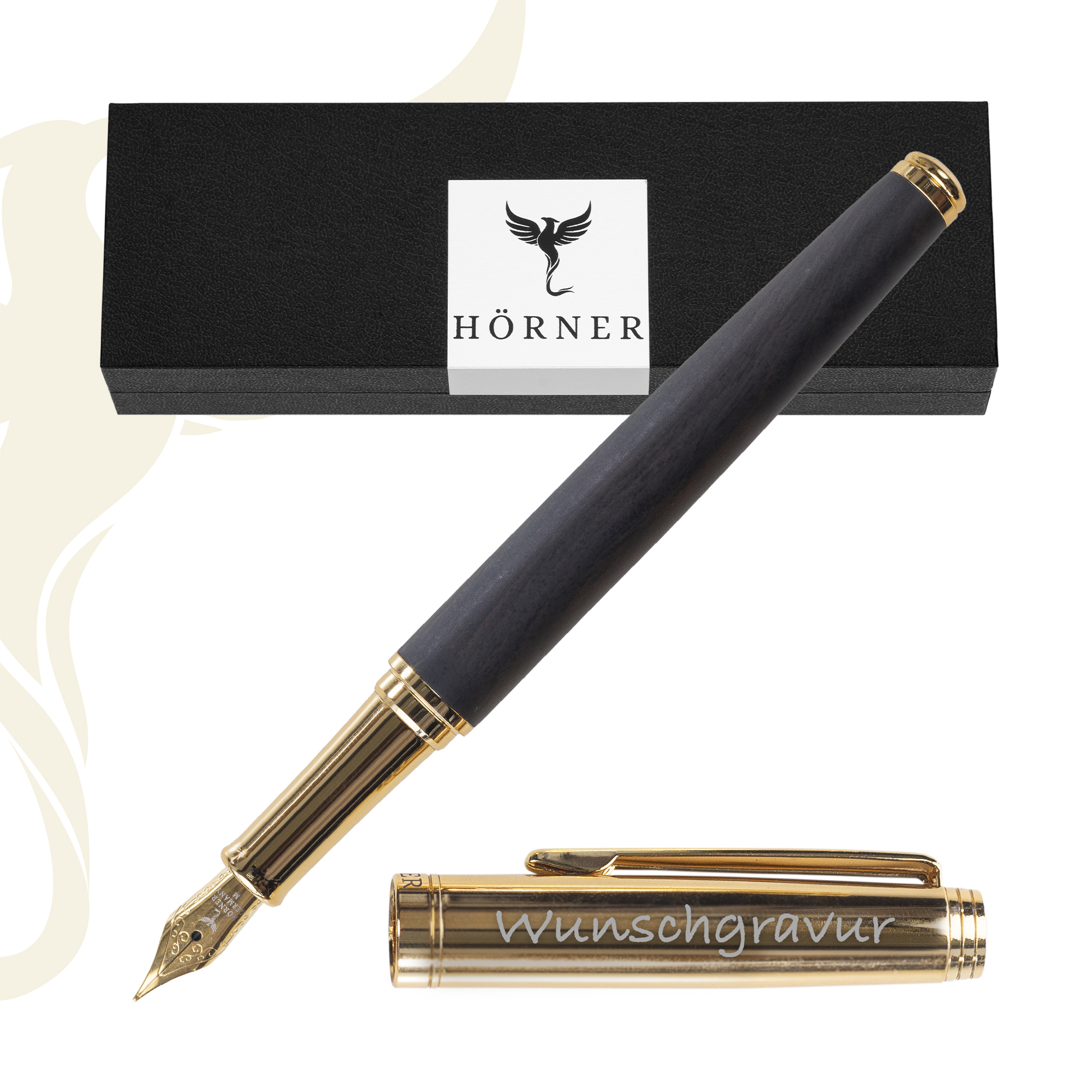
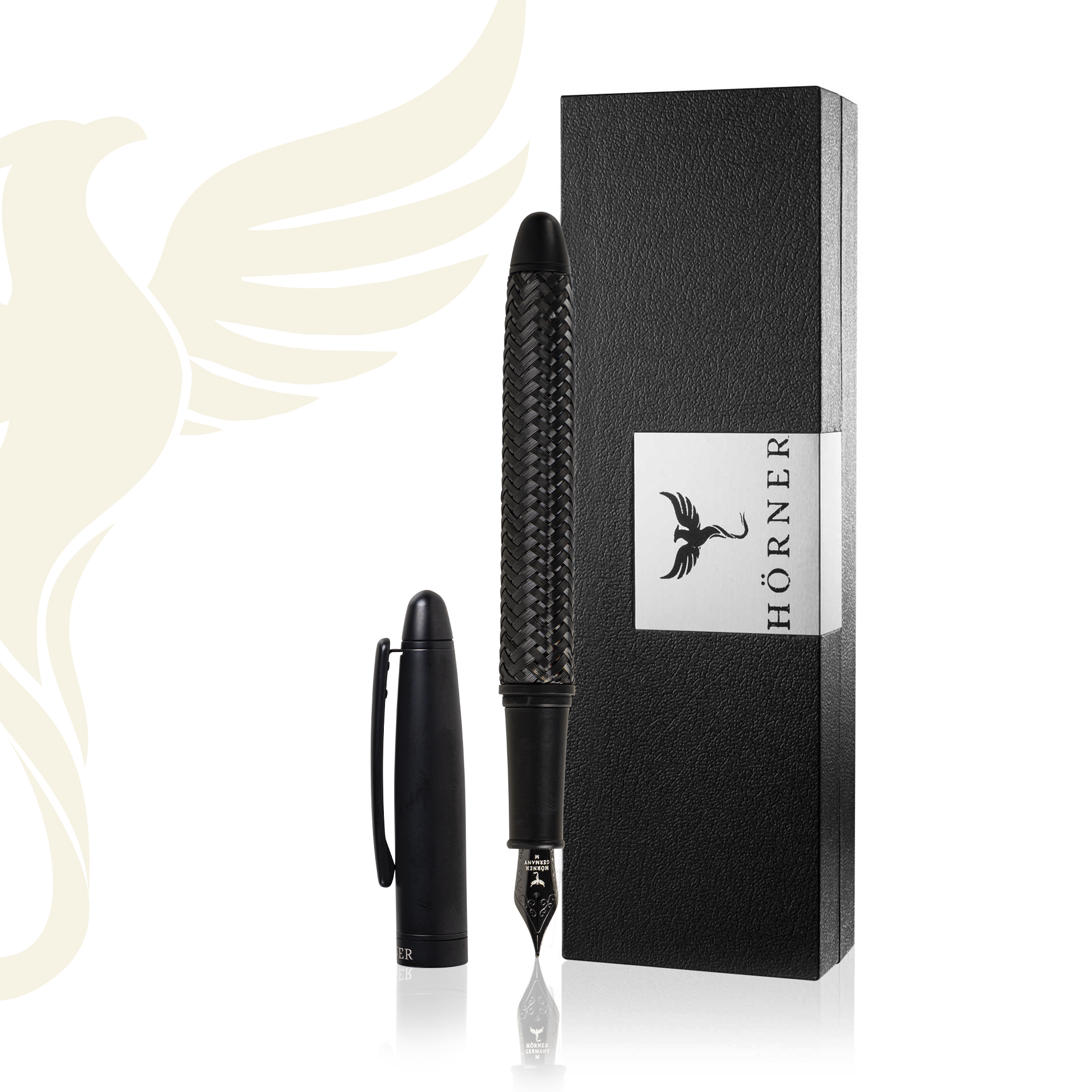
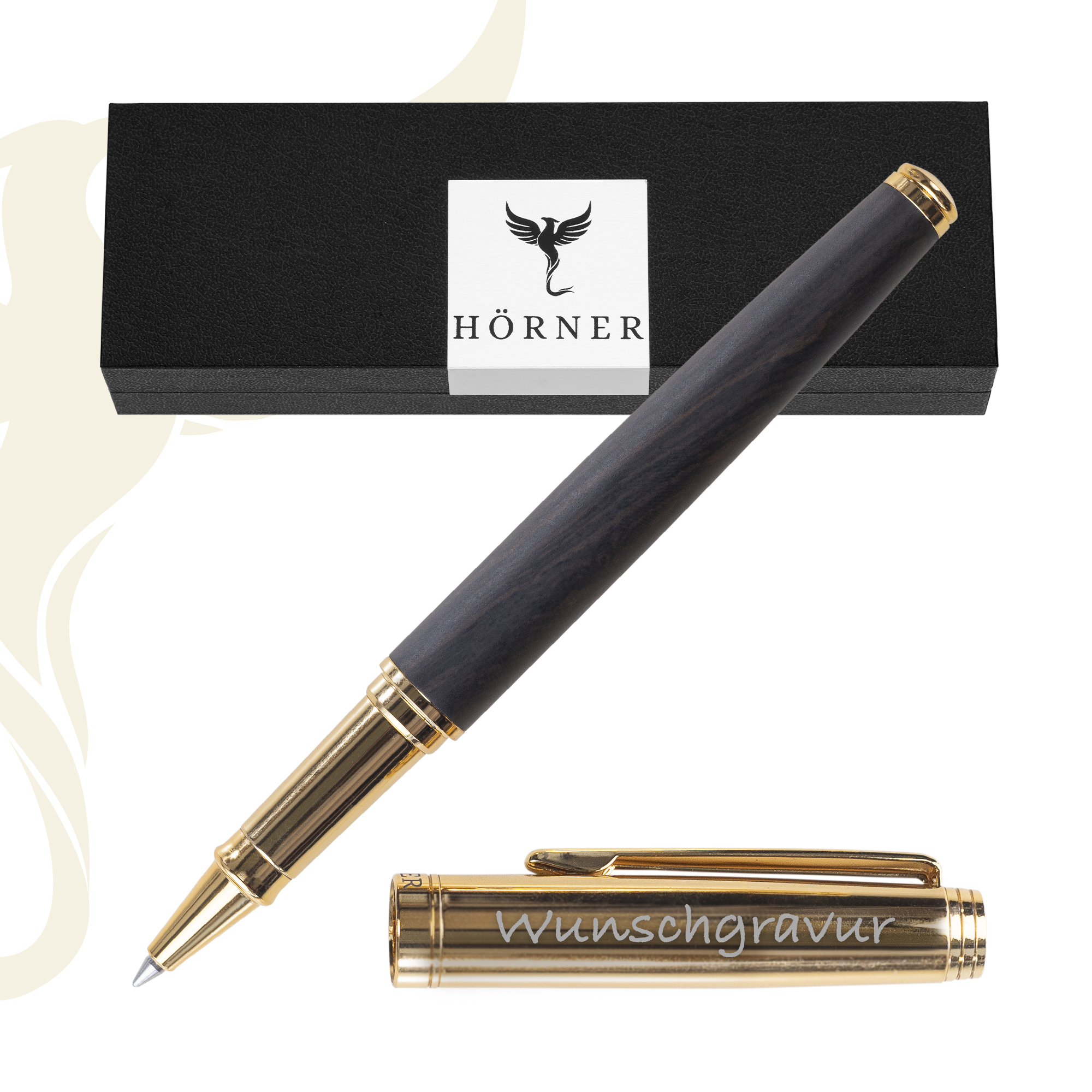
Those who value the written letter as a personal sign will find a complete overview in the Hörner fountain pen category. For gifts to those in mourning or for your own equipment, all models can be personally engraved.
Writing a sympathy card, answered compactly.
What is the best thing to write in a sympathy card?
How do you express condolences briefly in writing?
How do you formulate sympathy?
How do you write a sympathy card with sincere condolences?
What do you write in a sympathy card for an elderly person?
What do you write on the envelope of a sympathy card?
How do you write a sympathy card to distant acquaintances?
Which salutation is appropriate on a sympathy card?
Which phrases should be avoided in a sympathy card?
When do you send a sympathy card?
Can you send a sympathy card via WhatsApp?
Should you include money with the sympathy card?
Written with care. Kept with appreciation.
A handwritten card shows that you have taken the time. With a smooth-running fountain pen or rollerball, the handwriting becomes more composed, the words more carefully chosen. Hörner writing instruments are made for letters that the recipient will keep.
