


Uncategorized
Everything You Have Always Wanted to Know About Ink
It is the lifeblood of every writer: ink. It turns thoughts into words and preserves them on paper. No fountain pen, no ballpoint pen, no rollerball pen can do without ink – not even the most expensive fountain pen in the world (provided its owner does not simply place it in a display case as an ornament, but actually intends to write with it).
But what exactly is ink? What is it made of, and how is it that we are able to write with it? Are there different kinds of ink, and what sets them apart? And why can some inks be removed quite easily, while others resist every attempt at erasure?
Questions upon questions – and in this blog post, we would like to provide a few answers.
What Does Ink Contain?
If one follows the Latin origin of the word “ink”, it simply means coloured water. And indeed, ink is broadly a mixture of water and colourants. Exactly which colourants are used and how they are introduced into the water varies according to the type of ink and, naturally, from one manufacturer to another. In addition, other substances are mixed in for preservation, for instance, so that the ink can be used for as long as possible.
A glance at history also gives an idea of what ink can consist of. Around 5,000 years ago, for example, ink was already being used in Egypt and China, made from soot and so-called gum water, a liquid obtained from certain trees. Another recipe relied on the ink sacs of cuttlefish. This produced a black-brown colourant known as sepia. Incidentally, the principle is still used today in the production of food colourings.
What Types of Ink Are There?
To be quite honest: we hardly know where to begin. There are simply so many different kinds of ink, and then in all manner of colours, that it is impossible to provide a complete overview.
So let us keep it as simple as possible – here are some of the most common types of ink:
-
Water-based inks:
These belong to the category of inks with soluble colourants – meaning that the dye used dissolves in water, so no colour particles settle out and the ink remains uniform. Water-based ink has the advantage of not usually bleeding through paper. However, it also dries comparatively slowly, and the risk of smudging is fairly high.
-
Solvent-based inks:
With solvent-based inks, which also belong to the inks with soluble colourants, the opposite is true: this ink dries relatively quickly, but it tends to spread, for example on paper. As a result, this type of ink is used chiefly for smooth surfaces such as film or glass.
-
Iron gall inks:
This type of ink has been in use for more than two millennia and was widespread from the Middle Ages until the early 20th century. It was once made from iron sulphate and oak galls, from which gallic acid was boiled out – hence the name. Iron gall ink is characterised by its high durability, which makes it suitable for archival purposes, but also brings the disadvantage that it is difficult to wash out of clothing, for instance. It is also not always suitable for use in fountain pens, as there is a risk of clogging – although user experience shows that some modern iron gall inks can indeed be fountain-pen friendly. Only a few manufacturers still offer this type of ink.
-
Pigmented inks:
Unlike the dyes used in inks with soluble colourants, pigments do not dissolve in water. This has the disadvantage that they settle relatively quickly at the bottom. Yet this ink also has a number of important strengths: colour intensity is high, these inks are lightfast and water-resistant. If archival permanence is desired, this is a major advantage.
-
Drawing ink:
This is something of an umbrella term, as there are numerous different kinds of drawing ink. They often consist of pigments and therefore have properties similar to pigmented inks. Thanks to an added binding agent, they often adhere better to paper. Because drawing ink is quite thick and also dries very quickly, it is not suitable for every application, especially not for printer cartridges, as printer nozzles would clog very quickly.
-
Gel inks:
These have been gaining ground significantly for several decades. They are, in effect, a pigmented water-based ink with a very distinctive flow behaviour. In its initial state, it is quite viscous, but as the pen is used it becomes more fluid and provides a soft, smooth writing experience. On paper, it shows through less strongly and does not blot.
Where Is Ink Used?
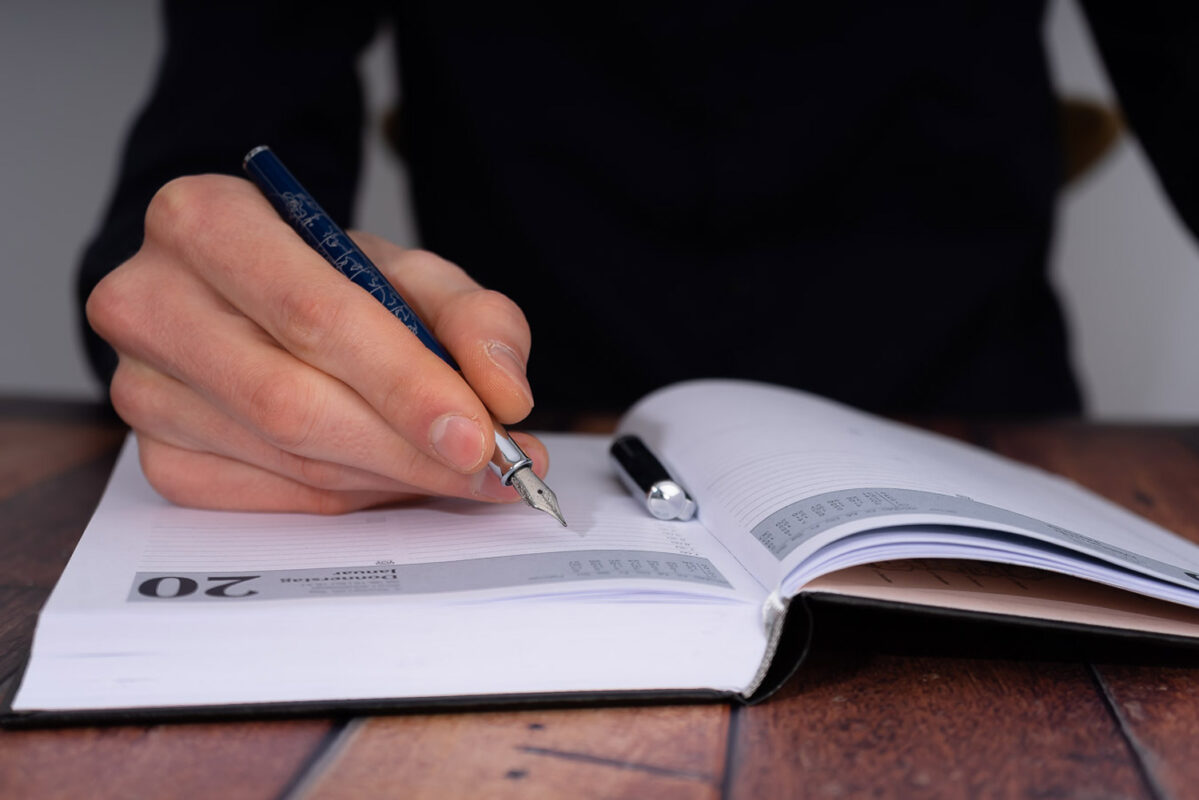
Traditionally, ink is of course used for writing by hand – in earlier times with quills, later with metal nibs, and nowadays with ballpoint pens, rollerball pens and fountain pens.
But that is far from all. Typewriters, for example, work with an inked ribbon, which is in effect a form of ink. And today, every office and almost every household has inkjet printers, which also rely on ink.
Stay fully up to date with our newsletter
And receive a 5% voucher for your order as a thank-you
[cleverreach form=275818]
Which Ink Is Best Suited to Fountain Pens?
There is no single perfect fountain pen ink, because much depends on the writer’s own preferences and what qualities matter most to them. In general terms, however, inks for fountain pens should
- dry as quickly as possible, so that they do not spread on the paper,
- be water-resistant and adhere well to the paper,
- yet still be washable, should an ink blot find its way onto clothing,
- not clog the fountain pen, and
- depending on the application, perhaps also be suitable for archival use.
Each manufacturer has its own recipe for fountain pen ink cartridges or bottled inks, which naturally it does not disclose. For everyday use, however, specialist retailers offer numerous high-performing water-resistant fountain pen inks that are ideally suited to writing on paper.
How Many Pages Can You Write with One Ink Cartridge?
How long you can write with a certain amount of ink depends on many different factors. One is simply how much ink the cartridge actually contains. It is also important to know on what medium you are writing. Other factors include the material and, above all, the size of the nib.
Fountain pen nibs come in different sizes. There are very fine nibs (F nibs), but also very broad nibs (extra broad BB nibs). Naturally, narrower nibs lay down significantly less ink on the paper for a given word than extra broad nibs.
Classic fountain pen cartridges contain 1 ml of ink. On average, they achieve a writing distance of around 300 metres – corresponding to the use of medium nibs (M nibs), such as those used for Hörner fountain pens. A standard cartridge therefore comfortably suffices for 10 to 20 A4 pages and, when using a fine nib, quite possibly for the opening chapters of a first novel.
What Does Archival Ink Mean?
The term archival permanence appears again and again when one looks into pens. Ink with archival properties is characterised by a high degree of durability and is resistant to water and light. What matters is that the writing remains recognisable even after a long period of time, at least in its essential form. This is especially important for official documents and signatures on contracts.
For example, rollerball pens are generally considered suitable for documents, as their ink dries quickly, remains highly legible and is water-resistant.
Iron gall ink and other types of pigmented ink are generally regarded as fundamentally suitable for archival use.
What Is a Fountain Pen Converter?
Anyone who thinks of fountain pens often thinks immediately of school days and ink cartridges. But there are also other filling systems by which the ink reaches the nib and then the paper. Writers are therefore faced with a choice between cartridge fountain pens, piston fountain pens and converters.
Piston fountain pens are writing instruments in which the ink is filled directly into a reservoir permanently connected to the pen, the piston chamber. Converters take up this idea and make it compatible with classic cartridge fountain pens. For converters for fountain pens are, ultimately, nothing other than interchangeable piston units that are fitted to a cartridge fountain pen in place of a cartridge.
The advantages of these converters are obvious. The writer can always fill the ink of their choice and can therefore switch regularly between different inks. And unlike a piston fountain pen, both the converter and the fountain pen can be cleaned easily.
How Long Does Ink Last?
Ink does not have a true expiry date. If it is stored properly – in the dark rather than in the light, neither too warm nor too cold, and at a stable temperature – it can still be used for writing even after 10 years. As a rule, however, manufacturers advise using ink within 12 months.
After a certain amount of time, the ink may dry out, meaning the water content evaporates. With pigment-based inks, the pigments may settle and render the ink unusable. In both cases, the result may be that the fountain pen becomes clogged, damaged and, in the worst case, unusable.
Can You Make Ink Yourself?
The clear answer: yes. And anyone who looks online will quickly find a great many different “recipes”, ranging from instructions for inks in every conceivable colour to inks made from natural materials.
In a particularly informative video, for instance, an expert from the University of Augsburg explains how iron gall ink can be made at home.
Those who enjoy autumn walks can even find ingredients for ink in the woods. Oak leaves with small spherical growths in which the oak gall wasp has laid its larvae are the basic ingredient of this ink recipe from Focus. The oak galls left by the hatched larvae are placed in water and an iron nail is added. Leave it for a few weeks and you have ink.
How Can Ink Be Removed?
Important though it is for ink to last, sometimes one does want to remove something written from the paper again – or perhaps a tablecloth or garment has been stained with ink and the blot now needs to be washed out.
Let us begin with paper. Ink eradicators are available in shops for this purpose, but household remedies can also usually remove ink, although often not entirely without residue. Nail varnish remover and alcohol are suitable examples. Both can be applied directly, or with a cotton pad, to the ink stain or the word to be removed, and then wiped away. Vinegar is also a tried-and-tested remedy: simply leave it to work for a few minutes and, if necessary with a little washing-up liquid, wipe the ink from the paper.
Vinegar or milk, for example, are also suitable household remedies for washing ink stains out of clothing.
Channel Recommendation
The YouTuber Big-G ́s Tintenkiste regularly produces detailed tests of various inks. We would be pleased to recommend his channel here; there you can learn all about the latest stationery products.
You are currently viewing placeholder content from Standard. To access the actual content, please click the button below. Please note that data will be shared with third-party providers in the process.
What Do Bleeding, Sheen, Ghosting and More Mean? A Brief Ink Glossary
In connection with ink, one repeatedly comes across terms that are not immediately self-explanatory. With our brief glossary on ink, we would like to clarify them.
When discussing ink, one often speaks of bleeding. This refers to the ink pressing through to the reverse side – and in the worst case even onto the next sheet. Sometimes this is due to very watery ink, but often the paper is the cause. It is an ink characteristic best avoided.
The term appears in printing. It is one of the four primary colours from which a printer can mix virtually any colour. In classical colour theory, cyan corresponds to blue. The other three primary printing colours are black, yellow and magenta.
Lorem ipsum dolor sit amet, consectetuer adipiscing elit, sed diam nonummy nibh euismod tincidunt ut laoreet dolore magna aliquam erat volutpat.
Ghosting is a kind of milder version of bleeding. The ink does not actually pass through the paper, so it does not bleed, but the writing can still be seen from the reverse side.
A converter is an accessory that turns a cartridge fountain pen into a piston filler. It is a kind of refillable ink cartridge that can be fitted to a cartridge fountain pen in place of the classic cartridge. With a converter, the ink can be changed at will, which is especially interesting for frequent writers.
In printing, the colour magenta corresponds to red in classical colour theory and, together with the other three printing colours black, yellow and cyan, can be mixed into all manner of colours. Magenta is a somewhat pinkish shade.
Pigments are colourants which, unlike other dyes, are insoluble. Thus there are – as mentioned above – pigmented inks, which are especially vivid in colour and also lightfast and water-resistant. However, pigments also settle easily and quickly, which is a disadvantage compared with water-soluble dyes.
This describes the shading of ink. It means that where a great deal of ink is laid down on the paper, it appears darker than in places with less ink. The result is a shadow effect. This is not a defect in quality, but simply explained by various ink properties.
This refers to an effect in which the ink shows a second hue, for example when a blue ink has a red cast.
This effect is very similar to sheen, but is caused by glitter particles contained in the ink.
The term refers to the viscosity of ink. Water-soluble inks are more fluid than, for example, drawing ink.
Final Thoughts
Ink has been known to humankind for five millennia and has always been used for drawing and writing, and with the advent of computers and printers also for printing. Today, the variety of inks is virtually endless, and for every application – from writing with a penholder to calligraphy – there are specialised inks.
Although internet tutorials make it relatively easy to produce ink yourself, we would advise against mixing different purchased inks together in an attempt to achieve new colour effects. Their chemical properties are not always compatible with one another – and in the worst case, the result may damage the fountain pen.
Aside from that, however, the rule is simple: everyone is sure to find the ink they like best.