


Uncategorized
What makes a good fountain pen?
Short answer: A good fountain pen is defined by three core characteristics: high-quality material (metal or wood rather than plastic), a precisely made nib (stainless steel or gold with an iridium tip) and a flexible ink system (a converter for freedom of ink choice). The investment is worthwhile – with proper care, a high-quality fountain pen can accompany you for a lifetime.
We are asked this question time and again – and it is as simple and perfectly natural as it is, at the same time, not so easy to answer: What makes a good fountain pen?
Why is the answer difficult even for us as experts? Because there is no single definitive answer; it depends on a great many factors. Individual, personal factors such as what you intend to use the pen for, how often you will use it and, for example, whether you are right- or left-handed.
And of course, anyone looking for the best fountain pen for themselves must also make a decision on price: while the world’s most expensive fountain pen, priced at 2.4 million euros, is undoubtedly one of the finest pens of its kind, it is certainly not the first choice for most of us when looking for a good fountain pen.
So how do you go about finding an excellent fountain pen? Quite simply: Read the following blog post and discover what to look out for when buying one.
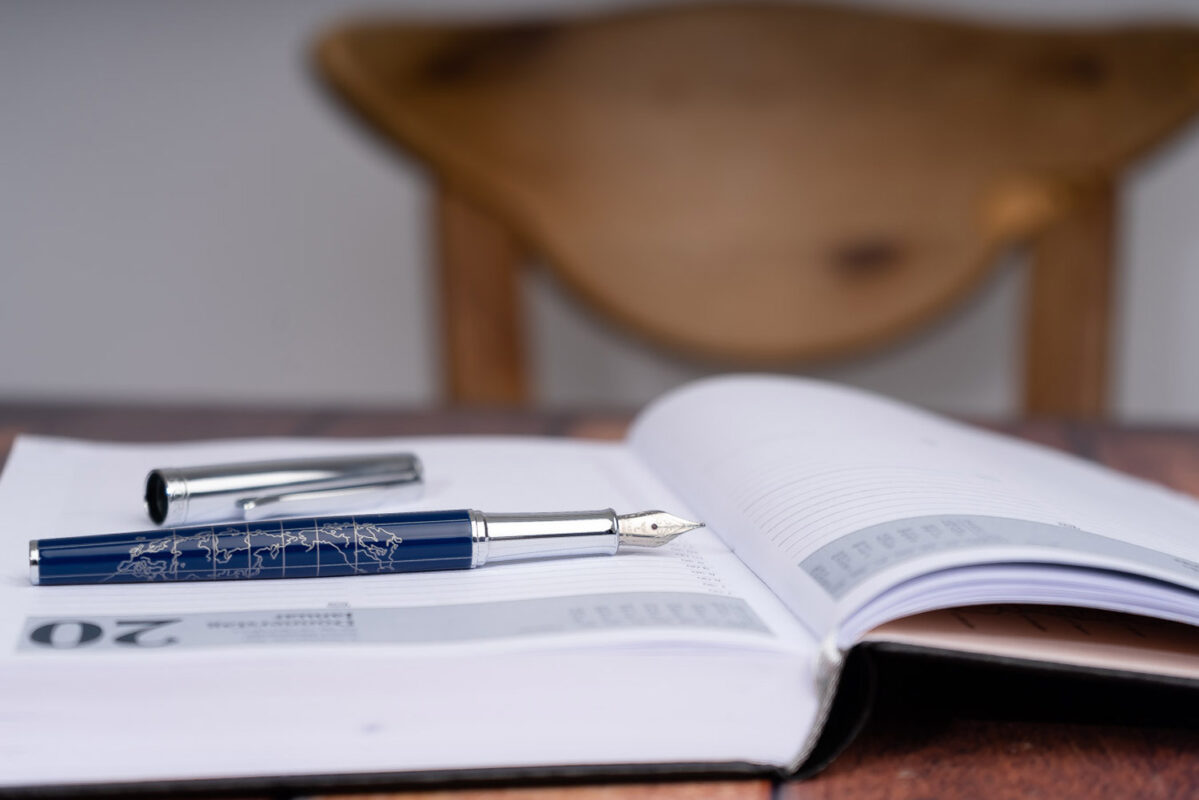
What types of fountain pen are there: from cartridge pens to piston fillers and converters
First, a very brief introduction to fountain pens so that we are speaking about the same things. There are different types of fountain pen, each with its own particular features. Alongside classic cartridge fountain pens, familiar to most of us from our school days, there are also piston fillers. The difference is this: in a cartridge pen, the ink is supplied via a replaceable cartridge, whereas in a piston filler it is drawn in via a refillable piston. The advantage is that you can use whichever ink you please and even switch between different colours.
In addition, there are converters. These are an accessory for your cartridge fountain pen that effectively turns it into a kind of piston filler. Instead of inserting a cartridge, you fit the converter and enjoy the advantages of a piston-filling system.
In our blog post “Piston filler or converter: which system is better”, we look more closely at the differences and offer helpful guidance when deciding which type of fountain pen is right for you.
Stay fully up to date with our newsletter
And receive a 5% discount voucher for your order as a thank-you
[cleverreach form=275818]The different elements of a fountain pen – and what matters for you
Apart from the type of ink delivery, fountain pens are generally constructed in much the same way. They consist of a barrel or body, a front section with grip, and a cap. Inside, you will find an ink cartridge or ink piston, a feed, and a nib. That already covers all the elements that can make the difference between fountain pen A and fountain pen B.
And although we do not wish to pretend that the study of fountain pens is a science, things do become a little more complex at this point. But do not worry: we shall make it as straightforward as possible for you.
The exterior: material, design and workmanship of a fountain pen
Of course, you should like the look of your new fountain pen. So you will naturally pay attention to its exterior. The barrel, grip section and cap can vary greatly in how they are made.
- The material: As a rule, fountain pens can be divided into two material categories: plastic and metal. It is no secret when we say that, in terms of robustness, quality and longevity, fountain pens made from brass or, for example, the Hörner One fountain pen in carbon, are clearly preferable. Metal fountain pens are, however, heavier than those made from plastic or precious resin – which, as we shall explain further below, is not a disadvantage.
Particularly important is high-quality workmanship with metal used at the strategic points of a fountain pen: the threads. Be sure to pay close attention to quality here so that your writing instrument does not wear out quickly (plastic threads are prone to breaking).
There are, by the way, also fountain pens made of wood. They are more individual and consequently more expensive.
The choice of material has a direct influence on tactile feel and service life. Ebony, for example, reaches a density of 1,000 to 1,200 kg/m³ according to the International Association of Wood Anatomists (IAWA) – twice that of oak. This exceptional density gives wooden fountain pens a pleasing weight and a surface that becomes more beautiful with every touch. - The design: Wooden and metal fountain pens impress with an endless variety of design options that make each fountain pen individual and distinctive. In this way, your pen becomes more than a simple writing instrument – it becomes a status symbol. An elegant fountain pen makes a finer impression on a desk than a plastic promotional biro.
Professionals often pay close attention to the design of the cap and clip. A metal clip becomes an accessory that complements a suit. Materials such as silver or gold add that special finishing touch. Metal fountain pens often stand out through a modern design that underlines the character of their owner.
The interior: ink system and nib
As with people, so with fountain pens: it is not only the exterior that matters, but above all the inner values. They are what define character. A fountain pen is no different in this respect. Two elements are especially important:
- The ink system: As mentioned above, there are cartridge fountain pens and piston fillers, each with its own ink system. In a cartridge pen, the ink is supplied via a cartridge that can be replaced and is usually not reusable. A piston filler is a fountain pen in which the ink is drawn into a piston mechanism connected to the front section of the pen.
The advantage of a piston filler is that you can fill the reservoir with your own ink. Any ink available on the market is suitable, giving you the freedom to experiment with colours.
For anyone who owns a classic cartridge fountain pen but would still like to benefit from the advantages of a piston filler, there are converters. These are a kind of piston in cartridge form and can be fitted to a cartridge fountain pen. The converter, too, can be filled with the ink of your choice. Converters are an affordable alternative to a comparatively expensive piston filler if you wish to upgrade a cartridge fountain pen. - The nib: The nib applies the ink to the paper. It is the heart of every fountain pen. With the right nib, you can enjoy a smooth flow of writing without scratchiness and present your handwriting at its best.
When choosing a nib, you should never economise on quality. Our nibs are made in Germany and impress with smooth writing performance and long service life.
Fountain pen nibs are generally made from stainless steel, and sometimes from gold. While the material is ultimately largely a matter of taste, the key consideration when choosing a nib is its width, or writing line. Most manufacturers distinguish between F (fine), M (medium) and B (broad), as well as several intermediate widths. In addition, there are special fountain pen nibs for beginners (A) and nibs for left-handers (LH). In our blog post “Nib guide from A to XF: which nib is right for your fountain pen”, you will find all the essential information about fountain pen nibs.
Research also shows why it is worth choosing a high-quality fountain pen with care: a widely noted Princeton University study (Mueller & Oppenheimer, Psychological Science, 2014) found that writing by hand supports conceptual understanding more strongly than typing. A well-balanced fountain pen enhances this effect through consistent ink flow and comfortable writing pressure.
Technical data at a glance
| Feature | Cartridge fountain pen | Converter | Piston filler |
|---|---|---|---|
| Ink capacity | approx. 0.8 ml | approx. 0.7 ml | approx. 1.5 ml |
| Ink choice | Manufacturer cartridges | Free choice (300+ inks) | Free choice |
| Changing colours | Cumbersome | Easy | Easy |
| Price level | Affordable | Mid-range | Premium |
| Recommendation | Beginners | Flexibility | Connoisseurs |
| Nib feature | Stainless steel | 14K gold | 18K gold |
|---|---|---|---|
| Gold content | 0 % | 58.5 % | 75 % |
| Nib tip | Iridium | Iridium | Iridium |
| Tip hardness | approx. 2,200 HV | approx. 2,200 HV | approx. 2,200 HV |
| Writing feel | Firm, direct | Slightly springy | Soft, smooth |
| Service life | Very long | Very long | Very long |
Good to know: Regardless of the nib material, the nib tip is made from iridium or a platinum-containing alloy. That is why modern stainless-steel nibs write almost as well as gold nibs – the main difference lies in the flexibility of the nib body.
Writing characteristics – and what weight and balance have to do with them
The basis for a pleasant writing experience is the nib. If, for example, you wish to write long texts frequently with your fountain pen, a fine (F) or extra-fine nib (EF/XF) is recommended, as this produces a particularly soft and refined writing result. Typical signature pens for business use, by contrast, are often fitted with broad nibs. Left-handers, meanwhile, should definitely choose LH nibs, as these are specially angled. They are M nibs, in other words all-round nibs, but designed for writing with the left hand.
However, it is not only the nib that determines the writing qualities of a fountain pen. Weight and balance also play an important part in how well a pen sits in the hand. Metal fountain pens, for instance, are heavier than plastic ones, but for that very reason they feel steadier and more comfortable in use. Slim pens, on the other hand, can be harder to grip, especially for writers with larger hands, whereas thicker, more rounded fountain pens allow for an excellent grip and ideal balance.
Science confirms this as well: those who write consciously by hand benefit from it. Researchers at the Norwegian University of Science and Technology (NTNU, 2020) were able to show that handwriting activates broader areas of the brain than typing – another reason to invest in a writing instrument that feels right in the hand and invites you to write.
The shape of our Terra fountain pen is optimally balanced so that your fingers do not tire, even during longer writing sessions.
In brief: how to find a good fountain pen
We did not promise too much at the beginning of this article when we said that choosing the right fountain pen is complex, did we? Still, with the following three tips, we would like to make your decision a little easier in closing:
- Choose a fountain pen made from metal. Not only do stainless steel or carbon give a fountain pen a refined appearance, they are also clearly superior to plastic fountain pens in terms of quality.
- Make use of the advantages of converters. With an affordable converter, you can use a variety of inks with your cartridge fountain pen whenever you wish.
- Pay attention to the right nib. When choosing a nib, what matters is what you want to do with the fountain pen. A good compromise is an M nib, which we supply as standard with our fountain pens.
Would you like a little more guidance? In another blog post, we set out 6 reasons why you need a fountain pen.