


Uncategorized
Finding the right fountain pen: 7 things to consider before buying
Short answer: When buying a fountain pen, seven factors matter: material (metal or wood for durability), size and weight (suited to your hand size), ink system (a converter offers maximum flexibility), nib material (modern stainless steel nibs rival gold nibs), nib width (M is the all-rounder), grip section (lightly textured for a secure hold) and extras such as left-handed adaptation.
Most of us learnt to write with a fountain pen at school. What we were not taught is that there are many different fountain pens with countless distinct features – so that every style of writer can find the pen that suits them best.
Different materials, various nib widths, several ink systems: the range of options when buying a fountain pen is vast and difficult for non-specialists to navigate. Anyone wishing to buy an elegant fountain pen that looks impressive on the desk, feels comfortable in the hand and writes cleanly will, sooner or later, have to consider these details.
In this blog article, we explain how to find the right fountain pen and which 7 things you should consider before buying.
Structure
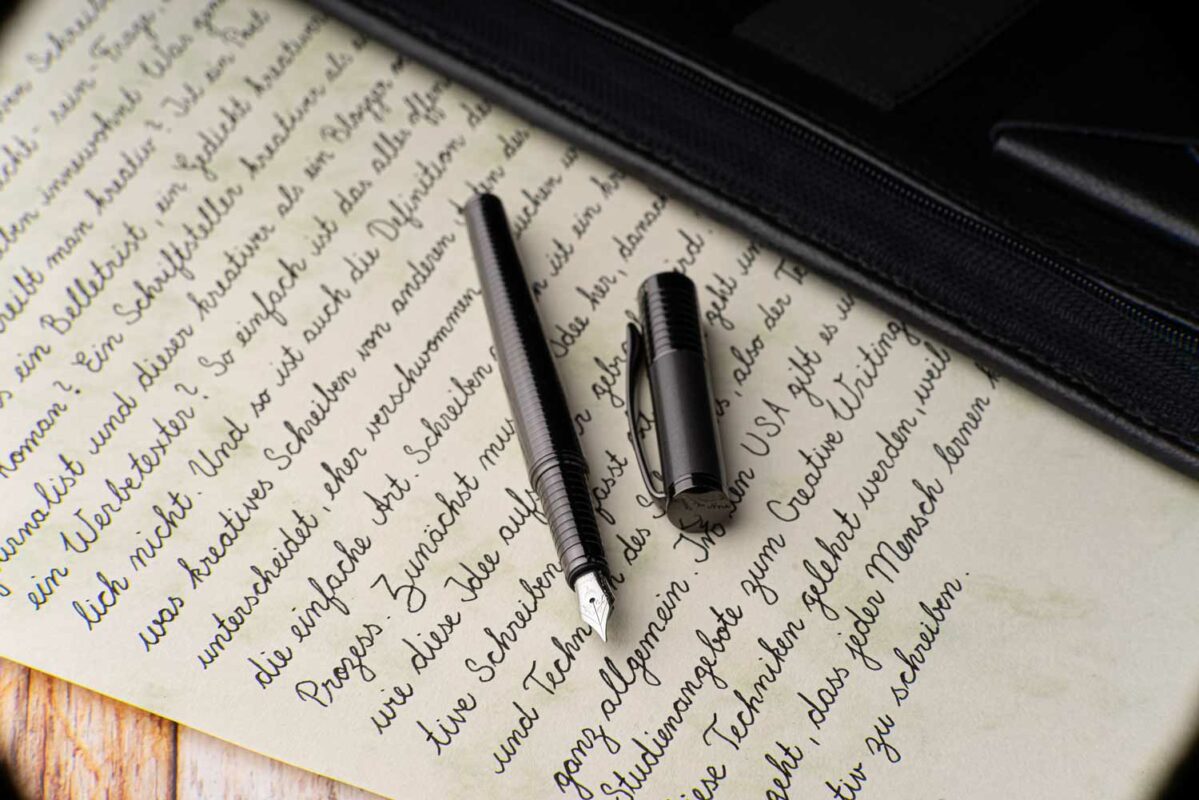
Fountain pens are, in principle, always built in the same way: they consist of a barrel, a front section with a grip section, and a cap. Added to this are an ink system and, of course, the nib.
As simple as the structure of a fountain pen may be, things become more complex when you take a closer look at the individual parts. With the barrel, the main question is which materials are used; with the grip section, it is the shape and how secure it feels while writing. Nibs differ not only in shape, finish and material, but also in width.
And as you will soon see, that is far from everything…
Material
Fountain pens can be made from many different materials. The classics are plastic and metal, though there are also pens made from wood or precious resin. Each material has its own distinct characteristics and therefore brings advantages and disadvantages alike.
- Plastic: The advantages of plastic fountain pens are obvious: they are light and inexpensive. Yet, as experience teaches us, “cheap” is not always synonymous with “robust” and “sustainable”. The lifespan of plastic fountain pens is shorter than that of metal models, for instance. Plastic is a poor choice especially around the thread, where the pen can break easily – and then the writing instrument is fit only for disposal.
- Metal: Fountain pens made of metal are significantly more robust and therefore more advisable. Not only do they have a much longer lifespan, they also make a finer visual impression than an inexpensive plastic fountain pen. And there is more: metal fountain pens feel weightier in the hand, which is not a disadvantage when writing but a considerable benefit. A particularly weighty fountain pen made of solid steel, for example, is generally better balanced, so you do not need to press as firmly to bring ink onto the paper.
- Precious resin: Fountain pens made of precious resin sit somewhere between the classic plastic and metal options, combining certain characteristics of both. Precious resin pens are more robust and longer-lasting than plastic ones, yet they are also very light – which may appeal to those who write a great deal and prefer a lighter writing instrument.
- Wood: Those seeking something distinctive often choose a wooden fountain pen. Distinctive here is meant quite literally, because wood offers unique tactile qualities. Anyone writing with a fountain pen made from, say, rosewood expresses an affinity with nature and may also appreciate that the pen acquires its own character with every use. In other words: patina. In terms of weight, wood sits between precious resin and metal. For writers who appreciate something out of the ordinary, wooden fountain pens are certainly worth considering.
With wooden fountain pens, it is worth looking at the material data: according to the USDA Forest Products Laboratory, ebony reaches a density of over 1,000 kg/m³, making it one of the hardest commercial woods in the world. These properties make it an ideal material for writing instruments intended to last for generations.
Size and weight
The dimensions and weight of a fountain pen are two characteristics that depend very much on personal preference and individual comfort. Here, more than in almost any other category, one golden rule applies: trying is better than theorising.
When it comes to size, the matter is usually fairly clear. Writers with very large hands often struggle with rather slim fountain pens, while large and wide pens can quickly feel too bulky for those with more delicate hands. Most writers prefer somewhat thicker, fuller fountain pens because they sit well in the hand and generally offer good balance.
Weight, however, is where opinions diverge sharply. Earlier, we said that heavier metal fountain pens sit better in the hand and provide a more pleasant writing experience, but that is only half the truth. Some writers, conversely, complain that the hand tires more quickly – which is why, especially for longer texts, they prefer a lighter fountain pen.
As with so many things in life, it ultimately comes down to taste.
Ink system
Now things become a little more concrete again. Three ink systems can be distinguished: classic cartridge fountain pens, piston fillers, and converters, which form the connecting element between the two systems.
- Cartridge fountain pens: Most of us know cartridge fountain pens from school. Ink is supplied through a standard cartridge, which can be replaced very easily. As a rule, the ink cartridge is used and then discarded afterwards (single-use system).
- Piston fillers: Piston fillers, by contrast, draw their ink from a piston mechanism that is filled with ink and can therefore be reused again and again (reusable system). The advantages: in principle, the ink never truly runs out, because the piston can simply be refilled. And the writer can use different inks, including inks in different colours. In another blog article, you can read everything you have always wanted to know about ink.
- Converter: A converter is a piston mechanism that can be fitted to a cartridge fountain pen. It allows owners of cartridge pens to enjoy the advantages of a piston filler and to use different inks as well. These converters are inexpensive and exceptionally practical.
In our blog article “Piston filler or converter: which system is better?” we take a closer look at the advantages and disadvantages of the various ink systems.
Nib
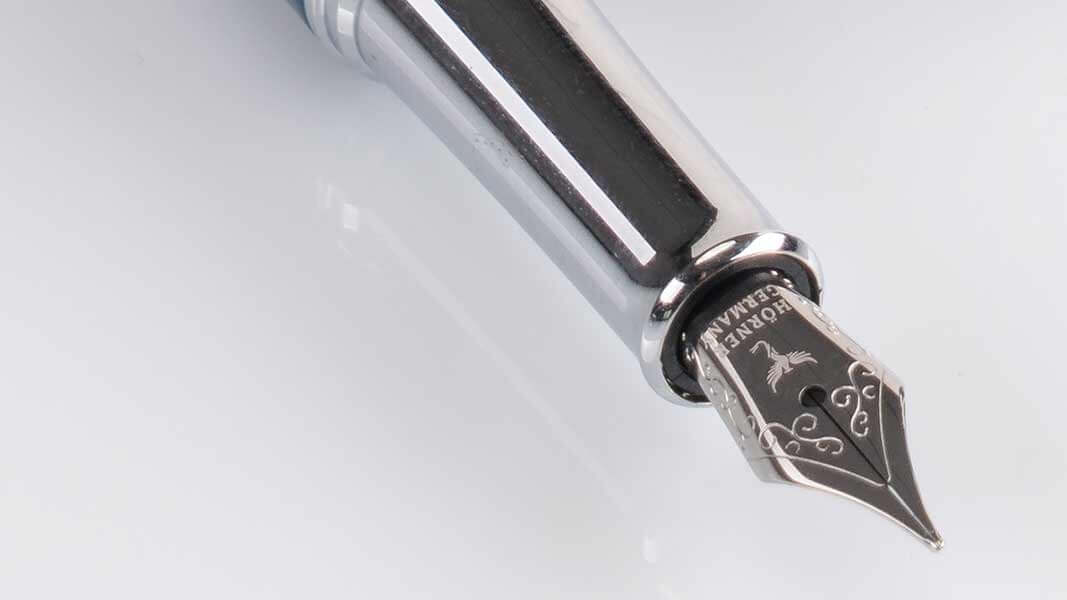
The heart of a fountain pen is, naturally, the nib. And it is hard to imagine just how many details can matter when choosing a nib – from the nib material and its shape to its firmness. And, of course, the writing width, which we will examine more closely in point 6 (writing width).
The key question regarding nib material is very simple: gold nib or steel nib? Our answer would be: it depends on personal preference.
For a long time, gold nibs were considered the ultimate choice because gold is more resistant and even acids could not harm it. Today, however, stainless steel nibs are fully comparable to gold nibs. Users no longer need fear rust and can still use a steel nib perfectly well even after years. The writing experience is also comparable, although gold nibs remain somewhat softer and therefore slightly more pleasant to write with.
Gold nibs, however, come at a price – and for many writers, the fairly substantial difference in cost is not justified by the comparatively modest advantages in writing when set against steel nibs.
And one more point: the truly critical part of a nib is the tip – and that is made neither of gold nor steel, but of iridium or a platinum-containing nickel alloy. These materials are considerably harder than both gold and steel and do not wear down as quickly. In writing, that matters greatly.
Regardless of nib material, one thing remains true: choosing to write with a fountain pen is worthwhile. A study by Princeton University (Mueller & Oppenheimer, Psychological Science, 2014) shows that writing by hand with a pen promotes conceptual understanding more strongly than typing on a keyboard. Researchers at the Norwegian University of Science and Technology (NTNU, 2020) confirmed this: handwriting activates broader areas of the brain than digital input.
Writing width
As already mentioned, the most important question concerning the nib is above all the nib width. We could write an entire book on this subject, but for now we have limited ourselves to a somewhat more detailed blog article on nib guide from A to XF.
The most important points, briefly summarised: there are different writing widths from very narrow to very broad, some of which are more or less suitable depending on personal preference and intended use. Standard nibs come in width M (for medium) and can be used for almost any purpose. A nibs are intended for beginners, are made of stainless steel and are very robust. These are the nibs with which primary school children learn to write. LH nibs, for example, are specially designed for left-handed writers and are cut at a particular angle.
Important: every manufacturer uses its own standards for nibs; there is no universal baseline standard. So when buying fountain pen nibs, always test whether a particular nib meets your expectations.
Nib widths at a glance
| Width | Abbreviation | Line width | Recommended for |
|---|---|---|---|
| Extra fine | EF / XF | approx. 0.3 mm | Small handwriting, technical drawings |
| Fine | F | approx. 0.5 mm | Everyday writing, small handwriting |
| Medium | M | approx. 0.7 mm | Universal use (80% of all applications) |
| Broad | B | approx. 1.0 mm | Signatures, calligraphy |
| Beginner | A | approx. 0.8 mm | New writers, robust |
| Left-handed | LH | approx. 0.7 mm | Special nib angle for left-handed writers |
Tip: Please note that every manufacturer uses its own standards. An M nib may vary in width depending on the brand. If in doubt, a comparison is advisable.
Extras
Fountain pens also come with extras – or rather, special details that can make an additional difference. This begins with the grip section, which should ideally be slightly textured so that it offers a truly secure hold, and extends to the cap, whose features may include a clip allowing the owner to attach the fountain pen to a jacket pocket.
And then there are the special fountain pen types. Alongside classic writing pens with the various characteristics described above, there are also special pens for calligraphy and fountain pens for left-handed writers. Left-handed writers do not pull the pen and nib across the paper in the way right-handed writers do; rather, they tend to push more. This requires certain adjustments, especially to the nib, which must be cut at a different angle than a classic right-handed nib.
You are currently viewing placeholder content from Standard. To access the actual content, please click the button below. Please note that doing so will share data with third-party providers.
In brief
If you were to combine every nib type, ink system, fountain pen material and writing width with one another, you would end up with 1001 different fountain pens. At the very least. The choice is therefore enormous, and every writer can certainly find the right fountain pen.
According to Grand View Research, the global market for writing instruments amounts to 17.5 billion US dollars (as of 2023). The premium segment in particular is growing at an above-average annual rate of 6.1 per cent – driven by the desire for personalisation and high-quality gifts.
The most important points are these:
- Choose a robust material such as metal or wood. Not only does this look more refined on the desk, it also significantly extends the lifespan of the fountain pen.
- Select the ink system that suits you. A cartridge fountain pen with converter is the most versatile option, as it allows you to use the full range of inks available on the market.
- Find the right nib. Especially at the beginning, M nibs are certainly the best choice, though frequent writers may in time prefer a slightly narrower nib.
That investing in a high-quality fountain pen pays off not only personally but also scientifically is supported by research from the University of Tokyo (Umejima et al., Frontiers in Behavioral Neuroscience, 2021): notes taken on paper lead to 25 per cent better memory performance than notes made on a tablet or smartphone.
Still unsure? In our blog article 6 reasons why you need a fountain pen, you are sure to find further inspiration.