

Uncategorized
8 Questions, 8 Answers: Everything You Need to Know About Ebony
Ebony is one of the most valuable types of wood in the world – and at the same time one of the most mysterious and mythical, surrounded by countless legends. This wood has long been credited with magical powers. Weapons made of ebony were said to be able to wound demons, and houses built from ebony were believed to enjoy strong protection against spirits.
Yet even for those who do not believe in magic, esotericism or ghosts, ebony holds a very special value. Its refined appearance, the hardness of the wood and not least the high prices commanded for ebony make this timber truly distinctive. Valuable musical instruments, furniture and high-quality writing sets made of ebony are therefore an expression of luxury and enjoyment.
But what exactly is ebony? And where does its enormous value come from? In this blog post, we explain it – and answer the most important questions about this very special natural material.
What is ebony?
There is not just one ebony tree, but several different kinds of ebony. Contrary to what one might think after hearing the fairy tale of Snow White in childhood, ebony is not necessarily black. There are indeed dark brown to black varieties, but also lighter, striped types of ebony such as Makassar ebony from Indonesia.
Ebony is considered one of the hardest woods in the world, although its density can vary considerably depending on the variety – as can the quality of the wood itself.
Only the denser, harder heartwood of ebony is valuable. In some trees, this makes up barely a third of the timber, whereas the outer wood – known technically as sapwood – is worth little more than ordinary beech.
Where does ebony grow?
Ebony is a non-European wood. It is found primarily in Africa and South-East Asia. The different types of wood often also carry the name of the country or region in which they grow, for example Cameroon ebony, Ceylon ebony and Madagascar ebony. Ebony trees also grow in Mauritius and Indonesia. In many parts of the world, these trees are now under special protection.

What does ebony look like?
In the fairy tale, ebony is black – as in Snow White’s hair, said to be as black as ebony.
And in reality?
There are indeed black ebonies such as Cameroon ebony, the most widely used variety worldwide. However, many kinds of ebony are also dark brown or display visible patterns, such as Makassar ebony from Indonesia, also known as zebrawood, whose otherwise black heartwood contains some strikingly light grain markings.
What properties does ebony have?
The most striking properties of ebony are its very dark, almost black colour without visible growth rings and the great hardness of the wood. These two characteristics make ebony an appealing material for furniture and as a premium timber.
In addition, the heartwood of ebony is often very fine-pored – a genuine mark of quality. This increases its strength and density and is one of the reasons why ebony has long been one of the most sought-after woods for furniture. Ebony is also highly durable and does not age dramatically.
Not least, ebony benefits from its strong visual distinction from other woods. With its dark colour and grain, it stands apart from the often lighter varieties of timber and, when polished, becomes a truly noble wood.

How expensive is ebony?
We mentioned it right at the beginning: ebony is expensive – very expensive indeed. While the price of a cubic metre of oak is put at around 1,500 euros, you may have to pay more than ten times as much for the same amount of ebony. Prices of 20,000 euros and more are not uncommon, although naturally this depends on the particular variety.
This high price is reflected throughout history, as ebony has always been extremely valuable. Yet there are other reasons too why this type of wood is especially costly – see the next question:
Why is ebony specially protected?
Ebony is one of the timbers threatened with extinction. There are around 100 species of ebony – and only two of them are considered not endangered.
Almost a third of ebony species are classified as severely endangered or threatened. These varieties are listed on the Red List and are specially protected. As a result, they are no longer found in regular trade – though unfortunately they still appear on the black market at times.
For this reason, proof of origin is required for many types of ebony. Anyone travelling, for example, with a musical instrument made of ebony must carry the appropriate documentation.

What is ebony used for?
Much like rosewood, ebony is used primarily for furniture and musical instruments. However, because of its high price, furniture-making has gradually become less important than it was a few centuries ago.
Instead, thanks to its properties, ebony is now found in hinges and is used for valuable inlay work. Keyboards, fingerboards and parts of woodwind instruments are made from ebony, as are decorative elements for furniture and cutlery.
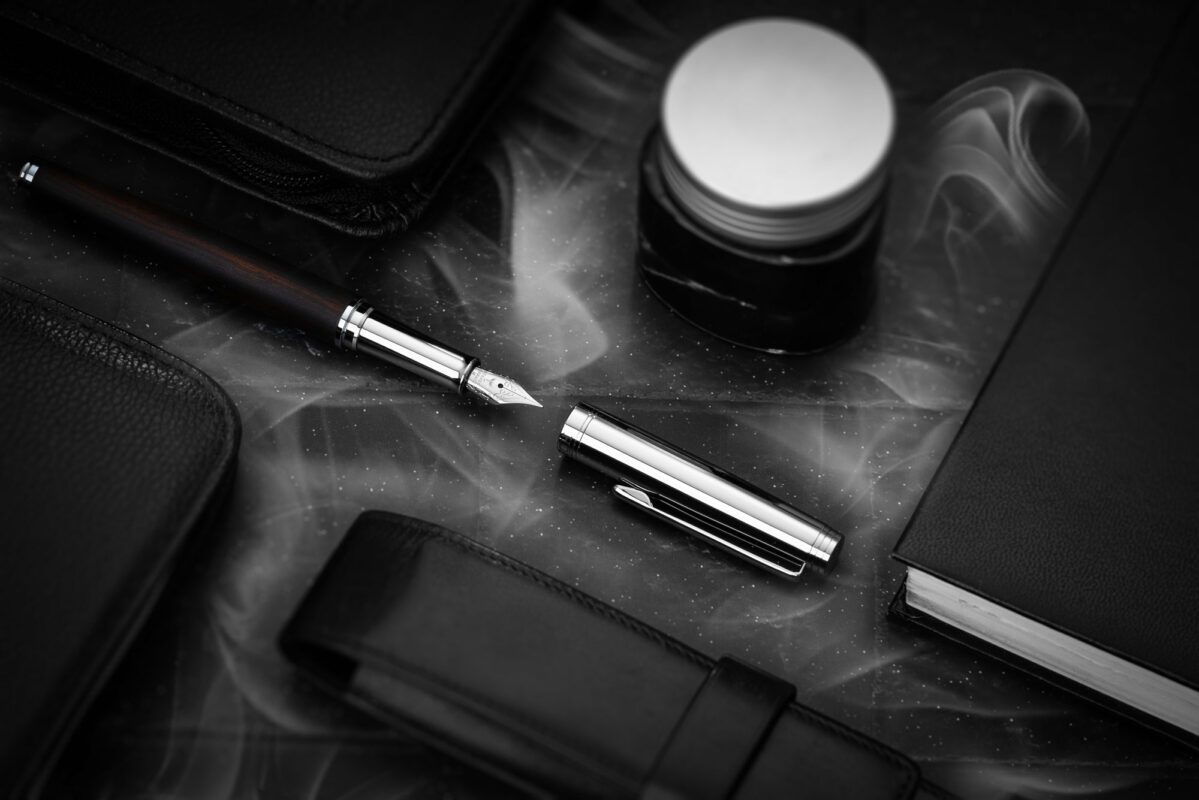
Valuable ballpoint pens and fountain pens made of ebony adorn the desks of discerning business leaders who appreciate the finer things. For this purpose, ebony is drawn from stocks of non-endangered species – refinement and sustainability go hand in hand.
What makes ebony so special?
Ebony is a truly mythical wood, steeped in legend. It has always enjoyed a special value, and not only in monetary terms. In the world of magic, ebony is said to ward off evil spirits. Magical objects were kept in ebony caskets because only there were they believed to retain their powers. Wands were made of ebony, and houses were set on ebony piles because, according to belief, spirits could not enter them.
But even beyond all superstition, ebony is unique. This wood is hard, resistant to weather and time, and therefore well suited to objects meant to endure. In past centuries, high-quality furniture was made from it.
Ebony was already mentioned in the Old Testament – as a traded commodity, underlining the value of this remarkable wood with its very dark colour.
Purely in terms of its physical properties, ebony can be replaced reasonably well in many applications by other woods such as native oak or beech. But the mythology surrounding ebony is truly one of a kind.
Refined ebony pens by Hörner
Hörner offers four quality ranges of ballpoint pens, fountain pens and rollerball pens made of ebony for cultivated connoisseurs and lovers of writing. The Legno fountain pen with its ebony barrel stands for timeless elegance, while the Parvus ballpoint pen made of ebony impresses with its compact size and light weight. Among the fountain pens, the Scriptum fountain pen with ebony barrel and cap, as well as a gold nib, is the undisputed flagship for anyone wishing to place a true one-off in exclusive luxury design on their desk. The Imperius series with rollerball pen, ballpoint pen and fountain pen is scarcely behind it in terms of refined form and elevates any suit.