

Uncategorized
6 Questions, 6 Answers: What Makes Mahogany Wood So Special
For centuries, mahogany has been regarded as a luxury wood and used for high-quality furniture and parquet flooring. Its dark colour brings warmth to houses and interiors, and it is widely appreciated for its excellent working properties.
Like all tropical woods, mahogany is not only refined and sought-after, but also expensive. In addition, it is under threat: some species are even endangered and appear on the Red List. As a result, they may no longer be felled or traded.
Fortunately, this does not apply to all mahogany species. Many are still used as a raw material for musical instruments, windows and furniture, as well as for ballpoint pens, billiard tables and even boatbuilding.
In this blog article, we explain the reasons behind mahogany’s enduring popularity, where the wood grows, and which types of mahogany are used for which purposes.
What is mahogany?
The mahogany family includes around 50 genera with more than 1,000 species — so there is no single mahogany tree, but rather an entire family. Mahogany occurs both as a tree and as a shrub. Some species can grow up to 70 metres tall.
The wood has a relatively high density and is therefore used as solid timber. Compared with, for example, ebony, which is considerably harder, mahogany is somewhat less dense. However, it is ideally suited to furniture-making — and is also less costly than the highly valuable ebony.
Where does mahogany grow?
Mahogany is a tropical wood and therefore grows primarily in tropical regions. Asia, Africa, Australia, and even Central and North America are among the regions where mahogany trees can be found.
And of course in South America as well. In the rainforest there, mahogany forms part of the natural landscape. Logging in areas such as the Amazon contributes to rainforest destruction, which is why the wood species found there are particularly protected under the Washington Convention on International Trade in Endangered Species.
The problem is that mahogany grows in a very scattered pattern — and in order to transport one of the trunks, some of which can reach circumferences of up to 3.5 metres, other trees often have to be felled as well. This destroys biodiversity and damages the ecosystem.
Other mahogany species from other parts of the world, such as American mahogany, which grows in North America and in some South American countries, are less problematic. If you would like to buy mahogany wood, you should definitely look for the FSC label for sustainable forestry. This certifies that environmental protection has been taken into account and that only wood from sustainable cultivation is used.
What does mahogany wood look like?
The heartwood of mahogany has a reddish-brown colouring that is fairly light, but can sometimes become darker. Mahogany is not as red as sandalwood nor as dark brown to black as ebony, but it certainly has its own distinctive colouring.
The sapwood, by contrast, meaning the outer wood, is more yellowish to greyish in tone and lighter overall.
Although some woods such as ebony are significantly darker, mahogany is still clearly considered one of the dark woods. Central European woods are — apart from a few exceptions such as cherry or walnut — much lighter and do not possess the characteristic reddish tone that defines mahogany and underpins its success in furniture-making.
What properties does mahogany wood have?
Alongside its striking colour, the working properties of mahogany wood are especially noteworthy. The wood is not overly dense and can be worked without great difficulty. Unlike ebony, which is very hard and fine-pored and therefore substantially denser, mahogany is easy to work with while still proving solid and durable.
How much does mahogany wood cost?
Mahogany is clearly among the more expensive wood species. In addition to the high quality of the wood, one reason for this is that trade in some mahogany species is restricted. In other words, the wood is scarce.
Mahogany is traded at around 4,000 euros per cubic metre of wood. That is a considerable amount when compared with the price of similarly high-quality oak, which is roughly half as much.
On the other hand, some other tropical and precious woods are significantly more expensive still. A cubic metre of ebony can cost 20,000 euros or more, while rosewood, depending on the variety, also costs between 10,000 and 15,000 euros.
What is mahogany wood used to make?
The list of things made from mahogany is fairly long. Among antique dealers, mahogany furniture is highly sought-after and demonstrates just how widespread this wood once was.
Today, however, fewer and fewer pieces of furniture are made from mahogany because the raw material is under threat. Even so, furniture-making has not dispensed with it entirely — and continues to use mahogany primarily in the luxury segment, for example on yachts or for high-end furniture.
In addition, veneers, musical instruments, windows, fine writing instruments and joinery are made from mahogany.
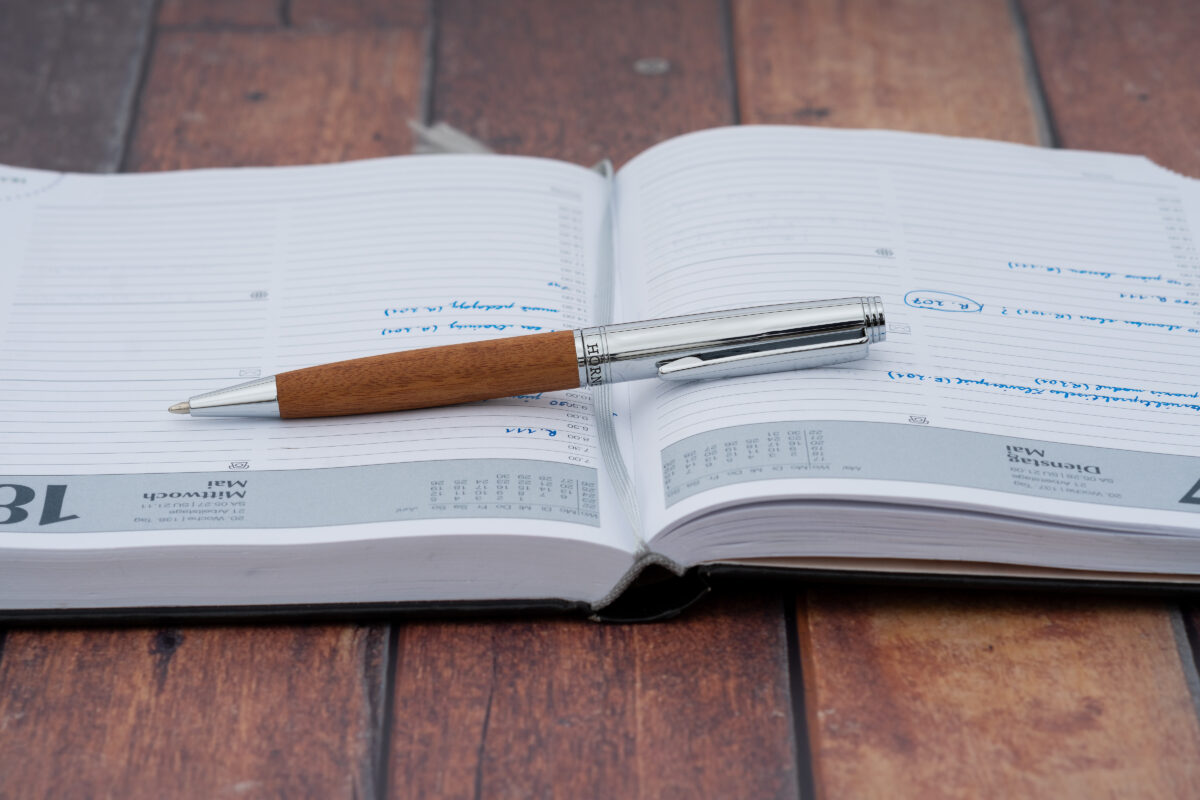
Ballpoint pens and rollerball pens in mahogany wood by Hörner
At Hörner, the Legno series focuses on wood and uses various types of wood for the barrel. The Legno ballpoint pen and the Legno rollerball pen are also available in mahogany wood. With their subtly reddish-brown colouring, they sit between the ballpoint and rollerball pens in rosewood, which is somewhat lighter, and sandalwood, which stands out with a stronger red hue. Legno writing instruments are also available as a mahogany writing set.