

Uncategorized
Calligraphy and the Art of Beautiful Writing
Calligraphy, the art of beautiful writing, is as old as the history of writing itself. It remains immensely popular to this day. And although handwriting has increasingly been pushed aside, first by the printing press and now by writing on computers and smartphones, a fine hand is still regarded as a mark of education and culture.
Yet to reduce calligraphy merely to attractive handwriting would be too narrow a view. Behind the art of beautiful writing by hand lies something far greater: a true art form, a way of embellishing and artistically shaping texts.
In this blog article, we would like to explain what calligraphy is, how beginners can learn calligraphy, and what makes it so appealing to all those who have chosen it as a hobby. We take a look at the modern calligraphy alphabet and offer tips on which pens are suitable for calligraphy.
What is calligraphy? A brief look at the history of writing
Let us begin with a brief look at history, which helps us understand what calligraphy is and where it comes from.
Calligraphy is in fact an extremely ancient art – the word itself comes from the Greek “kállos”, meaning “beauty” – in which people traditionally wrote with quills, brushes or other writing instruments, and in modern times, for example, with fountain pens. Documents in hieroglyphs have survived from antiquity, making them several thousand years old. With the invention of papyrus and writing with pens, scrolls could be produced fairly quickly, and demand grew for scribes who not only mastered reading and writing, but also understood how to write beautifully and with artistry.
Within Christianity, calligraphy was of inestimable importance. Copies of the Bible were produced in monasteries, and during the Middle Ages so-called writing rooms developed. Thus, splendid manuscripts were created in the scriptorium of Wiblingen Abbey, some of which survive to this day. In many other monasteries across Germany, too, monks devoted themselves to the art of beautiful writing.
More than handwriting: calligraphy as the art of beautiful writing
When we think of fine handwriting today, certain memories usually come to mind: of our first year at school, when we learned to write by hand. In a very broad sense, that is comparable with calligraphy. In reality, however, we are simply taught to write legibly – the artistic aspect is entirely neglected.
Yet it is precisely this artistic element that stands out in any definition of calligraphy. It may be described as the art of lettering, the art of beautiful writing, or decorative writing. At its core, calligraphy is not solely about writing itself, but about setting down particular forms, using design elements and creating ornamentation. In old documents, this is especially evident in the titles of works and chapters, whose letters were richly embellished and resembled true images. The pictorial quality of calligraphy is even more pronounced in Islamic and Jewish scripts than in Christianity and Europe, where there was no prohibition of images. In Islam and Judaism, writing therefore took on an even stronger visual and formative role.
Learning calligraphy: the internet offers everything you need
Anyone taking up calligraphy today is, of course, unlikely to have copying the Bible in mind. Modern calligraphy is a hobby, rather like painting watercolours or oils. In this sense, anyone can learn calligraphy. And paradoxically, it is the internet itself, with its automated typefaces, that offers guides such as “Calligraphy for beginners”.
From step-by-step guides and videos for self-teaching to complete courses, everything is available for those who wish to learn calligraphy. Materials such as lined paper for calligraphy and nibs for writing can be ordered without difficulty. Best of all, the art of beautiful writing is something anyone can develop at home on their own.
That said, calligraphy is like any other of the fine arts: it takes either considerable talent or a great deal of hard work to become truly good at it.
You are currently viewing placeholder content from Standard. To access the actual content, please click the button below. Please note that data will be shared with third-party providers.
Unblock contentCountless options: there are thousands of calligraphy scripts
It starts with the simple fact that there is no single definitive script. Just as we can choose from countless fonts on a computer, in calligraphy too we decide on a particular script style for a specific document. To give some sense of just how varied calligraphic scripts can be: the design experts at Canva offer 23 free calligraphy fonts – which is only a fraction of the thousands of styles that exist in the modern calligraphy alphabet.
In its article “Learning calligraphy made easy”, the website Farbcafé provides a particularly detailed guide to how anyone can gradually master the finer points of calligraphy. Among its resources are writing grids available for download, comparable to the lined sheets first-year pupils use when learning to write at school.
As in your first school year: first relearn handwriting
And just like children learning their letters in primary school, students on a calligraphy course begin in much the same way: with simple beautiful writing, as in the first year at school. For many of us, constant use of computers and keyboards has left the wrist rather out of practice, and we are no longer truly capable of producing neat handwriting.
Once those first-year handwriting basics have been absorbed again, practice sheets help learners begin with their first calligraphic scripts. Experts are very clear on one point: patience is essential. Just as scribes in monasteries were once rare and required years of practice before they could undertake major projects such as copying testaments, practice still makes perfect today. And that means that at times a single letter simply has to be written again and again until it is refined.
Dip pens, rollerballs and more: the right pen for every hand
The journey towards your first self-designed calligraphy card or first certificate is a long one. Even so, with the right materials, plenty of practice and a good measure of motivation, simple scripts can be achieved surprisingly soon.
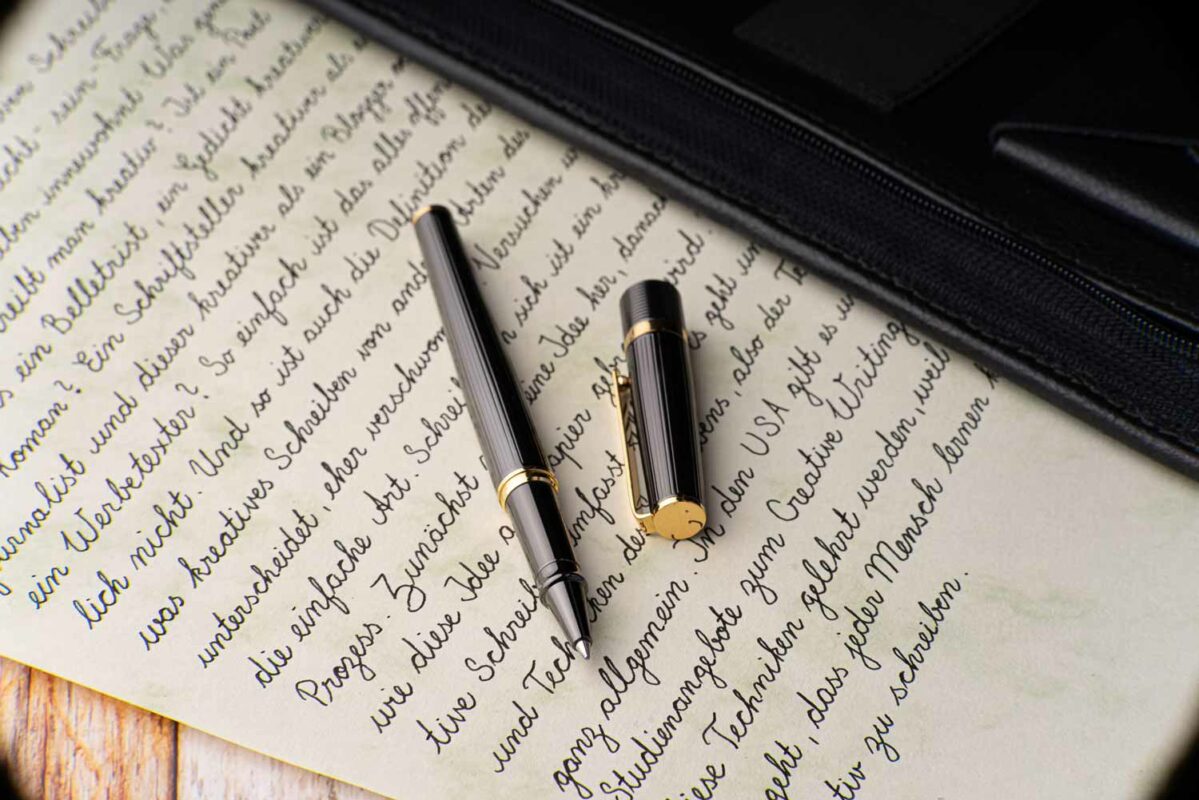
Then, of course, the question of the right nib arises. For writing, a high-quality fountain pen such as our Hörner Terra fountain pen is an excellent choice, while for more design-led calligraphy there are also specialised nibs available from specialist retailers. Goose quills of the sort we know from earlier times are, however, rarely used today. Instead, steel is the preferred material for nibs, although other pens such as rollerball pens are also favoured by many writers and lettering artists.
Do not miss any news!
Would you like to read more engaging articles? Then subscribe to our newsletter and, alongside exclusive products and offers, receive interesting blog posts on a range of business and lifestyle topics.
And best of all: as a thank-you for subscribing, you will receive a 5% discount voucher.
And why calligraphy?
In the end, one question remains: why is calligraphy enjoying such a strong revival today, when computers give us access to countless fonts and when, in terms of document design, we have an almost endless selection of layouts and stylistic tools at our disposal? Why do we make the effort to create something by hand on paper when software and a printer could produce it in a fraction of the time?
Quite simply because calligraphy has the power to draw us out of our hectic daily lives and carry us into a quieter age. As in the scriptoria of monasteries, where a diligent calm once prevailed, calligraphy still helps writers today to forget the stress around them and enter a kind of meditative concentration. Just as music does for some and painting for others, calligraphy is for those who enjoy writing by hand a way to switch off from daily life and step into an altogether different world: the world of beautiful writing, as the scholars of the Middle Ages understood it.